
To step into the world of Gustav Düsing is to enter a space where architecture behaves more like music than masonry. Whether he is freezing fabric into a structural “tent” or designing award-winning university hubs, Gustav’s work is a study in “productive friction” — the delicate point where radical transparency meets the human need for shelter. In this interview, we peel back the layers of a practice defined by more than just steel and glass. We discuss his “fresh air fetishism”, his skepticism of AI-driven perfection, and his unique philosophy of “The Wedding DJ” — the idea that great architecture must make everyone dance, from the academic theorist to the casual passerby.

-
FvF
You’ve just completed a milestone — perhaps the final handover of a project like the Studierendenhaus or your residency at Villa Massimo. After stressful months , the intensity shifts. What is the first mundane thing you crave?
Gustav DüsingAfter a hot design phase, I usually fall into a bit of a hole, and I need to let go of the design, stop thinking about it entirely. Then, I try take it easy, be at home more often, spend more time with the family, try to forget about work, sleep well, but then get back on the horse again rather soon.
Making music is quite a relief for me: I do jam sessions with my friends on a regular basis. There, I can totally let go, and they’re also really inspiring: To realise that things can happen in flow. Non-verbal communication with friends – that’s something I appreciate a lot.


-
FvF
What is your preferred sensory landscape?
Gustav DüsingMusic is really important to me, not just my jam sessions. At home, I recently started to introduce more tropical vibes. I just came back from Brazil, so currently we play a lot of Bossa Nova, which almost creates a bar vibe at ours. If things get very vibrant in here, with the kids around, Bohren & the Club of Gore is my secret remedy: Very dark doomsday Jazz – if you play that, everyone just chills out.
Lighting is also rather significant: I like to have lots of different possibilities: Small lights, and dimmers so I can set the mood. We have spotlights on our artworks, almost like in a museum. Very atmospheric. Sometimes I also like very bright light. In my studio, I have very white light, which keeps you awake and makes artworks look really good.
I have a sensitive nose, I need fresh air – I’m a typical German fresh air fetishist and need regular “Lüften”. It’s all about air hygiene for me: If the air is cold & fresh, I have the feeling that it is clean. If it’s warm & stuffy, I think it is filthy. We don’t use candles or room scents. Keep it clean and neutral.


-
FvF
Why Berlin?
Gustav DüsingI studied in London, but I couldn’t picture myself working there – it’s just too tough. And Berlin back then – with all my friends living in big, beautiful “Altbau” flats – sounded like paradise.
My residency in Rome was amazing, but I also realised at some point that network is very important. We have a lot of friends and family in Berlin, and I want to be able to see them regularly.
The city is still wild, and you have a lot of possibilities here. It’s still different to other cities. I was in Berghain yesterday with people from other cities, and they reminded me again these kind of venues are special, that the city is still a promise.


-
FvF
When you approach a new project, how do you find the balance between your personal artistic signature and the diverse, often conflicting expectations of the client and the public?
Gustav DüsingThere’s always something to do, especially if you’re confronted with new briefings all the time: There’s always something to dig in, to set up a narrative. In the beginning, we think about the appropriate answer to the question. I start by thinking about the audience. When I design a competition, I always compare it to a wedding, and you’re the DJ: You need to please the client –who might be your best friend – but you also have a certain style. So you need to get everyone dancing in style. That’s a principle I always apply when doing a competition: Contribute to the discourse, but also know that architecture is a public service. Pleasing the jury and the people that will inhabit the space – that’s architecture.
My credo: Don’t make it too complicated, but also don’t make it too simple. Legible architecture. There’s something for everyone.
There are different levels, the first view, then the larger questions – the more academic ones. Once they listen, you can drop these topics. On the last level, it becomes very technical: Connections, materials, sustainability. A good project means pleasing all three layers.


-
FvF
How do you resist the architectural urge to over-determine how a person should sit, move, or feel within a room?
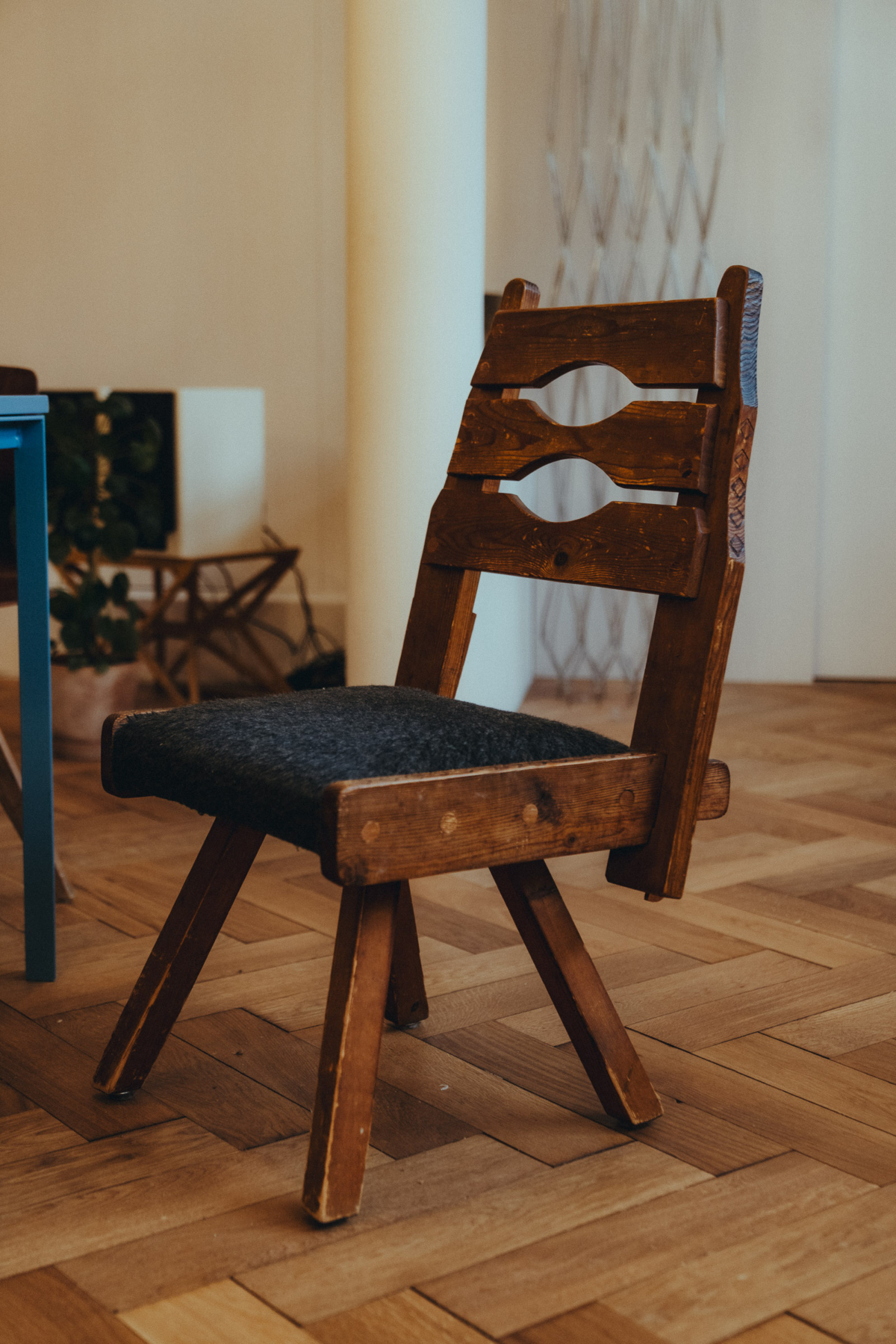
Gustav DüsingI am trying to resist defining exactly where people should sit or eat or talk by designing a space free of hierarchy. I work with an overarching spatial concept that is throughout the same: In the Studierendenhaus in Braunschweig, for example, there is no good or bad spot – it’s intuitively designed so people can decide on a place to dwell dependent on how they feel in a particular moment. For a concept like this, the space has to be flexible, also the furniture has to be light. There is no traffic zone, it’s really about undefined space in the end.


-
FvF
In an era of ‘starchitecture’ and heavy, permanent monuments, is your preference for light, adaptable, and almost ephemeral structures a form of resistance? Does the integrity of a well-designed, low-impact beam-and-column system feel like a political or ethical statement in a world facing issues like the climate crisis?
Gustav DüsingOne of the big challenges of architecture is to become more conscious in terms of material usage, and so I believe that taking material away from architecture also talks a little bit about our relationship with natural resources. I’m interested in asking the question of comfort in that regard, and also take the responsibility away from architecture to provide us with a well-tempered environment – towards a relationship with space where we as humans design new rituals, maybe even new fashion we can wear indoors, so we don’t have to load everything on architecture. So yes: Architecture that has a very decreased amount of materials is a political statement, which talks about a global and fair distribution of materials, and comfort.


-
FvF
Architecture requires immense confidence — you are responsible for the safety and comfort of others. How does vulnerability fit in here?
Gustav DüsingYou need to toughen up a lot in the world of architecture. I’m always very honest about leaving my comfort zone. I try to stick to the core discipline, and not try to be able to do everything myself, which probably makes me vulnerable every now and then.


-
FvF
Tell us a about your project “The Solid State of Matter”, also known as the Frozen Tent.
Gustav DüsingIt was originally created for the 2017 first and only Antarctic Biennale to which I was invited, and is a pretty radical investigation into the limits of shelter. It was a crazy project: A group of artists, philosophers, journalists, and one architect – that was me – were all put onto a research vessel to travel through Antarctica. It was a nomadic format of a Biennale – every now and then we went on shore, and for me as an architect I immediately thought of a tent structure. The tent is the original typology of Antartica – the first man-made structure out there was a tent. We can learn a lot from it as humans I think – how we deal with footprint, for example. The tent I created for this occasion consists of a fabric structure that becomes rigid and structural only when sprayed with water and frozen by the environment. It really works with the site conditions, and also talks about comfort. And on an aesthetic level, it really blends into the landscape of Antarctica: You can’t really tell if it’s an iceberg or a tent from further away.
-
FvF
You recently reconstructed the frozen tent in Berlin-Westend, close to your home. How does the ‘comfort’ of that structure change when it is placed in a domestic urban square versus the Antarctic wilderness?
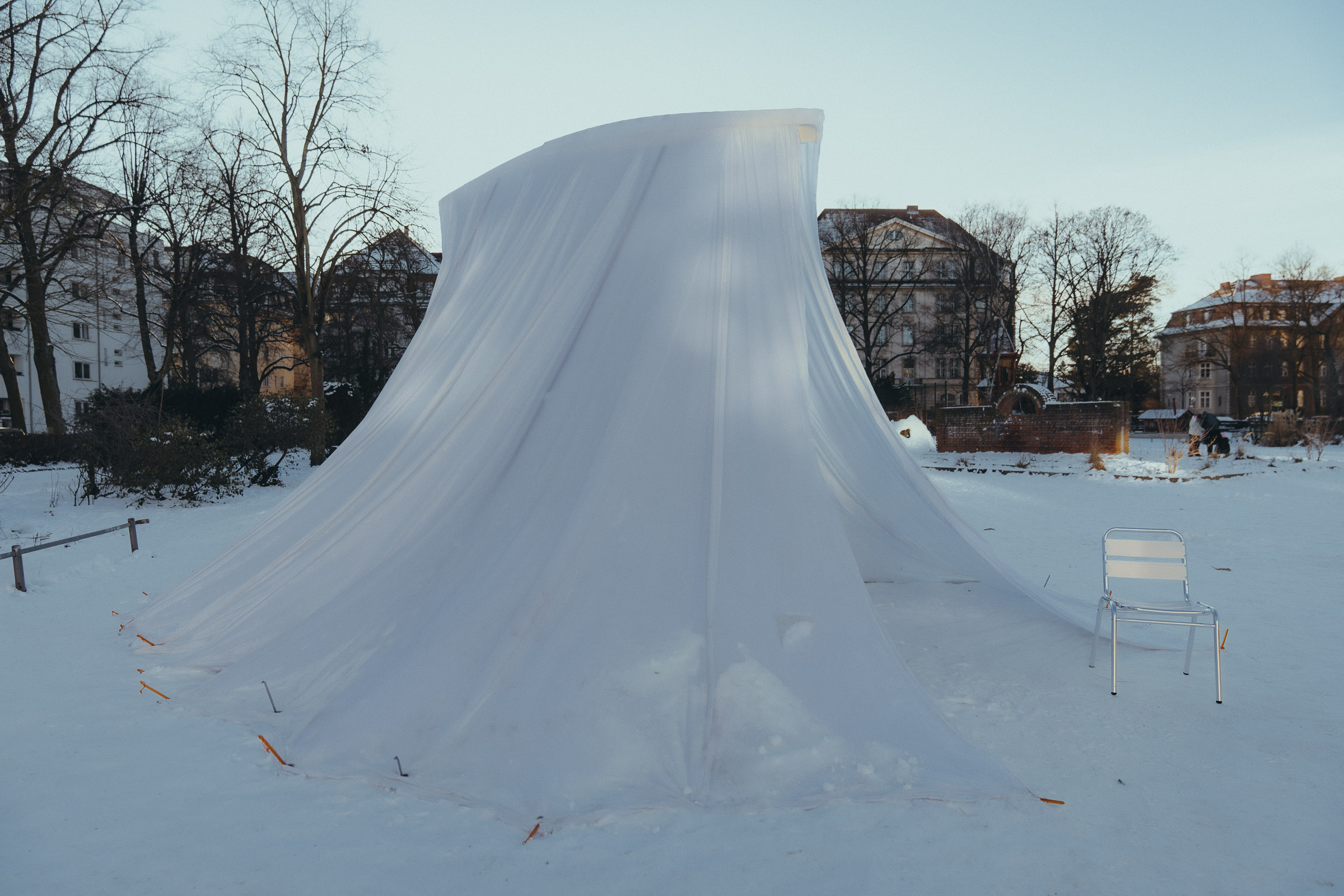
Gustav DüsingAbsolutely. It changed a lot. In Antarctica it was an experiment, an idea, a narrative. We didn’t hang out in the tent: We put it up, took photos, and took it down. It’s a very restricted environment, a very restricted continent.
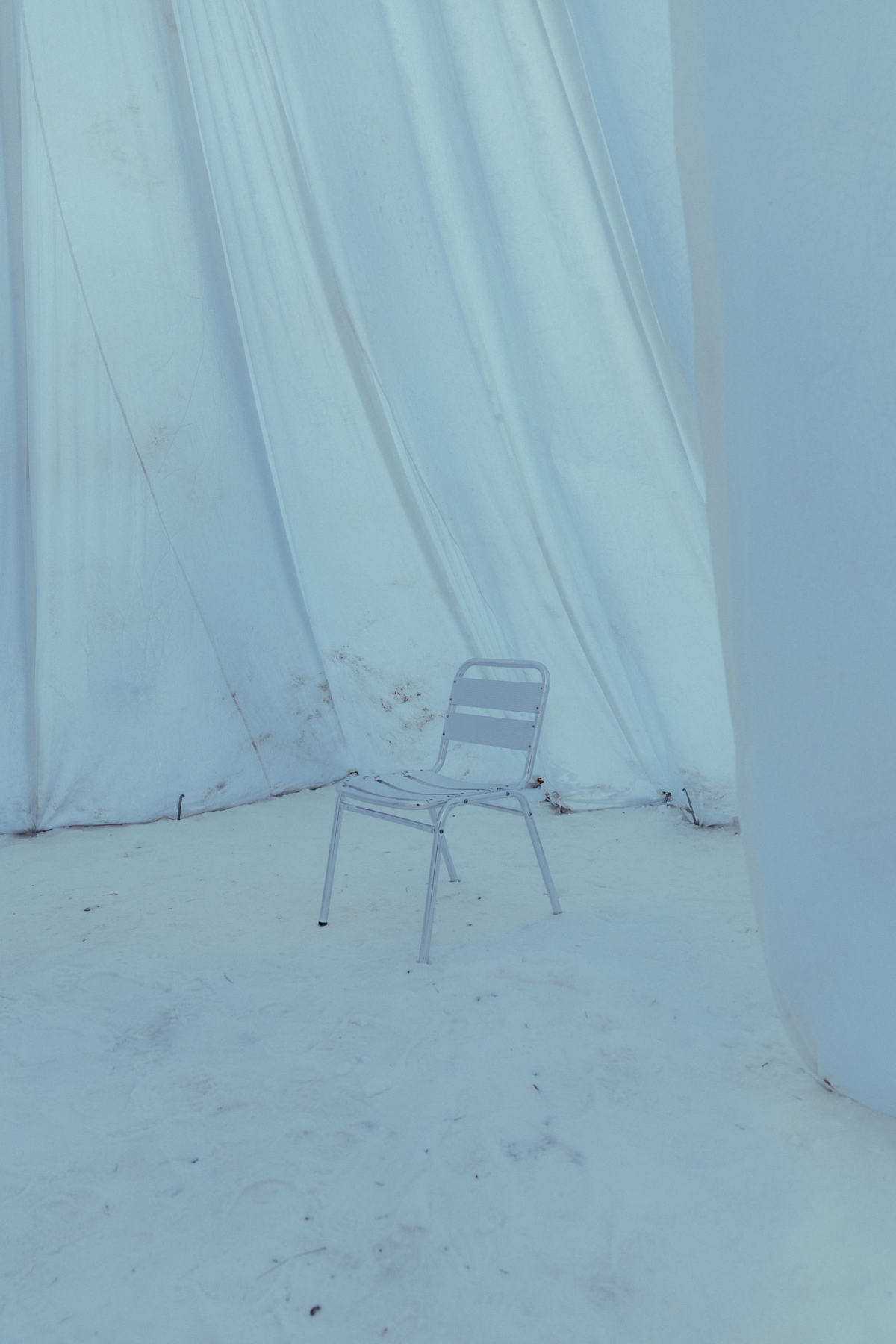
Here, it was more or less a community project. The tent was put up, and soon people started showing up and asked about it. They started taking over the space – it became a public space: It became dirty, kids were even smoking weed inside. I was fascinated about how it was immediately accepted – a very satisfying moment for me as an architect.

-
FvF
When discussing “comfort” in the context of the ice tent, the focus shifts from luxury to survival, transparency, and the psychological relationship between the body and a hostile climate. What’s your definition of comfort here?
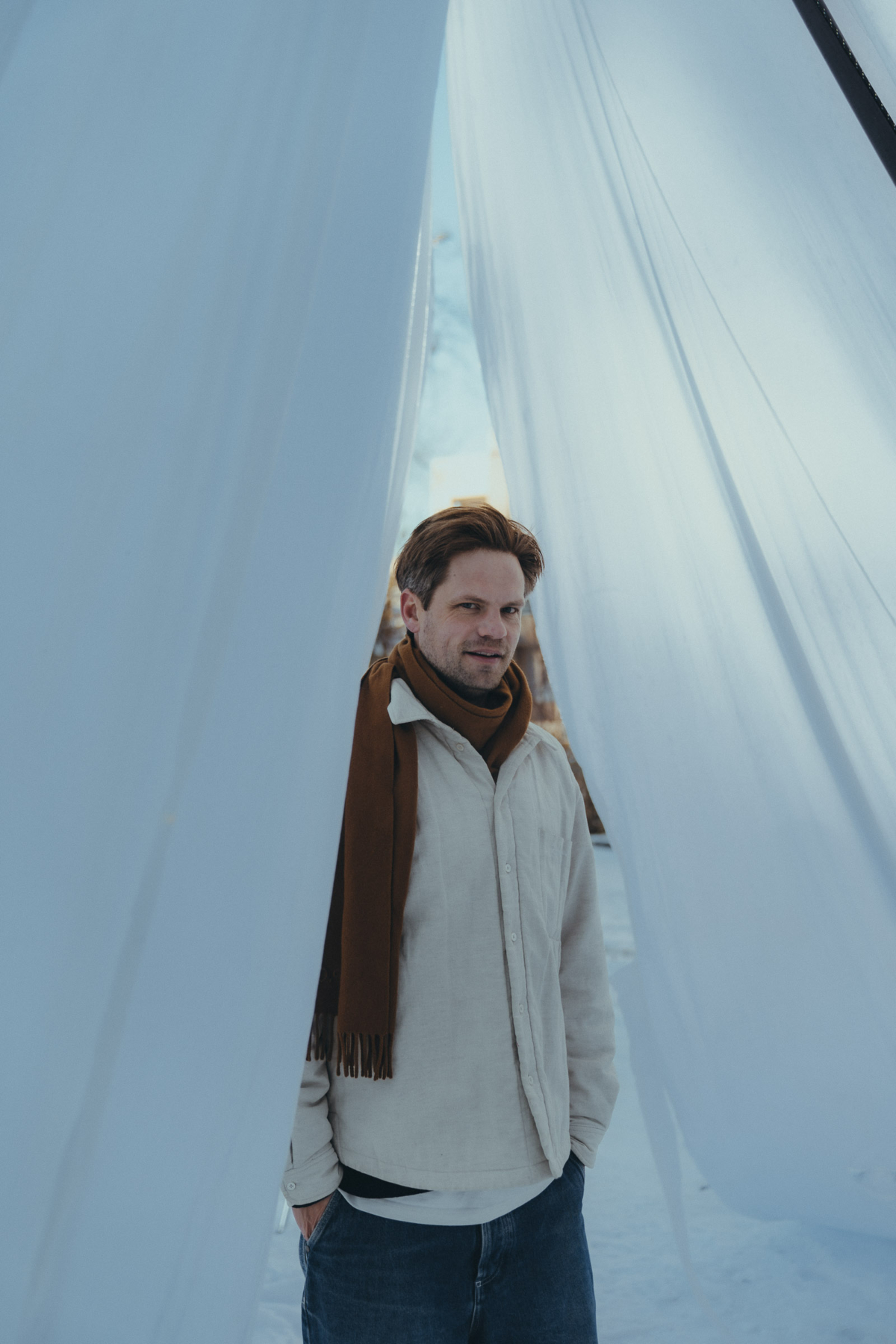
Gustav DüsingI’m interested in the relationship between a human and the shell that makes a human more comfortable – it’s a very scalable concept. If you wear a jacket, it’s close to your body, and it automatically comforts you. The larger you make the shell, the more public you also make it: You can invite people in. The inbetween layers – architecture that is half outside, half inside – are interesting to me, that I am researching a lot. It comes together with the idea of private and public – from private bedrooms, to more public living spaces. My idea is to decrease material, to use as little material as possible, but still create comfort.

-
FvF
You have mastered the technicalities of complex geometries. What still genuinely ‘scares’ you in a professional sense?
Gustav DüsingI know I’m a good architect and designer. But I haven’t been such a good manager for my studio. And that is something that really scares me. I’m determined to get better, and focus more on that part of my work in the future, too.


-
FvF
Your studio is filled with models & plans. Amidst these tools of the trade, is there one object that is essential to your well-being but rather unrelated to architecture?
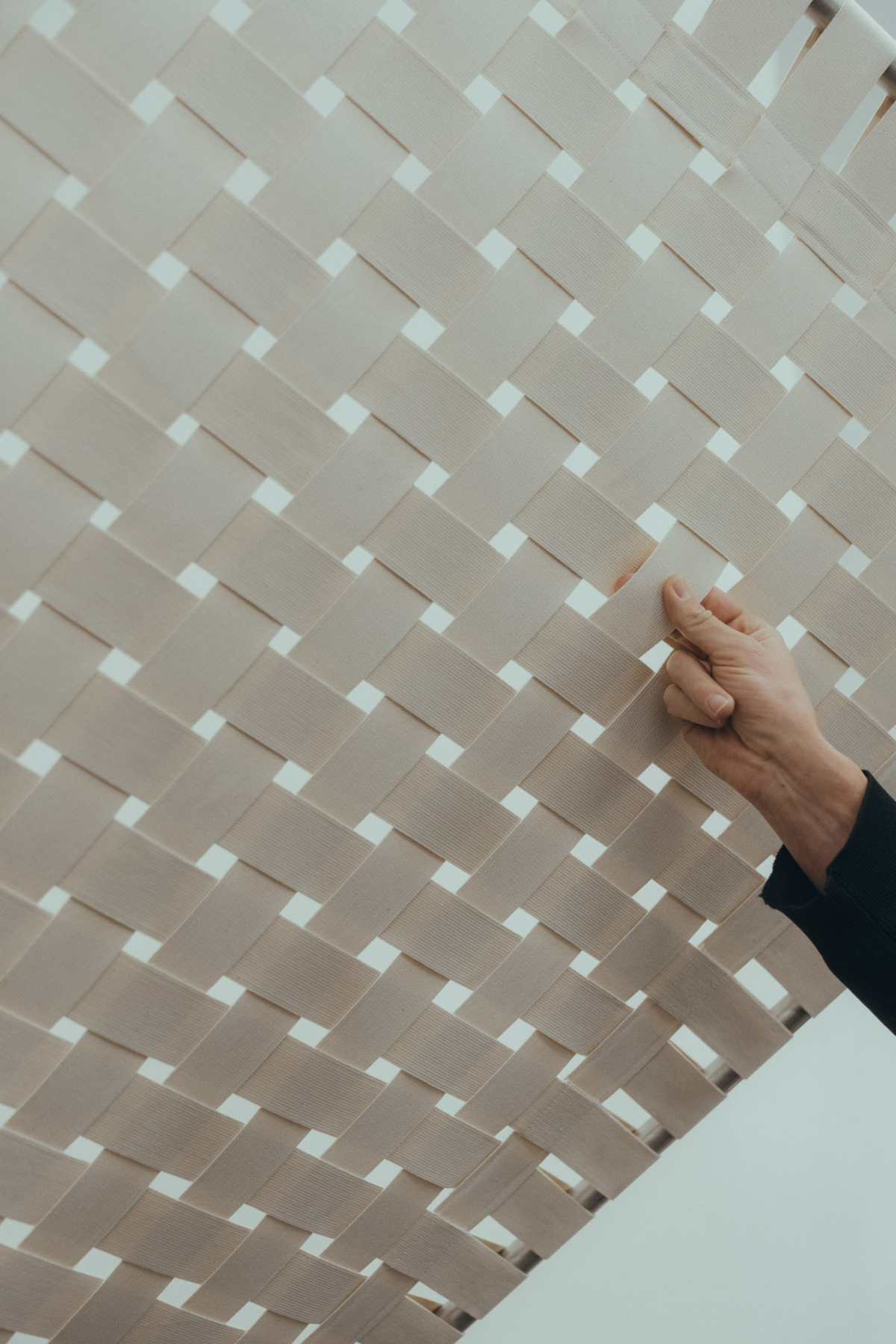
Gustav DüsingOur beautiful sound system, it’s very important. It was designed by a student of mine at UdK Berlin University of the Arts – Mariami Kurtishvili – and it’s called “ORCHID SOUND SYSTEM”. It’s about sounds & space, very much architectural. Mariami says it reframes urban listening as a form of acoustic ecology, where the city becomes host and amplifier of sonic intention. In the studio, we listen to music all the time. I DJ most of the day, and my team has to listen to it. I play a lot of ambient, experimental soundscapes, not so many vocals, more continuous sounds to get into a certain mood, a certain vibe. Music has a huge influence on how I design. I do lots of digging, and I have a huge musical archive.

-
FvF
Talk to us about “Picnic”…
Gustav DüsingI very much like the concept of picnic as a ritual, which talks about friends, family, small groups, to go out into nature and only bring the most necessary things to provide comfort. It’s all about mobility, scalability, leaving no footprint – a good picnicer would never leave anything behind. So I designed a kind of sunshading device, but it’s also spatial – and they can be combined.
It was used for the Berlin Art Week Garden in front of Gropius Bau, and was immediately occupied by visitors, even if it meant an effort – people had to crawl in and sit on the floor. I was there observing, and that was a beautiful moment. If you design a bird house, and then the bird checks it out and builds a nest – that’s so satisfying: A proof of concept moment.
If people have a choice, and can also NOT use a space, not going into a certain area – that’s my challenge to solve, that they naturally accept and populate the space.


-
FvF
Architecture is increasingly defined by parametric design and AI-driven optimization. How do you view these tools in your process?
Gustav DüsingThere’s definitely an interesting new player on the horizon, and that is AI. I will most definitely not let AI design: This is my favourite part, and I haven’t seen anything interesting coming out of AI in this area. I am also not letting AI write my essays, or other pieces of writing. We should really keep that for ourselves, add our personal style. In the day-to-day, I use AI a lot for project management and accounting. That makes me really happy, as it gives me more time for the things I love doing. A good piece of architecture should always have a lot of personality in it. I rather have an imperfect piece of architecture that someone takes responsibility for, than having a perfectly designed AI piece. I will always be an advocate for imperfection.


-
FvF
Traditional tents are opaque skins that hide the exterior. Your frozen tent is translucent, allowing the haunting light of a winter night to permeate the space. In such a frosty environment, should the ability to see the ‘inside’ from outside provide a form of comfort for the people within, or does it heighten the sense of vulnerability?
Gustav DüsingThat’s a very original architectural question. There is translucency – you see shadows and movements, but can’t really identify individuals – or there’s actual transparency, where you see everything. I mostly work on public spaces – translucency is great for that. Showing that this is an inhabitable structure and that people do stuff in there is inviting more people in. And like that it becomes richer – I like that a lot.


