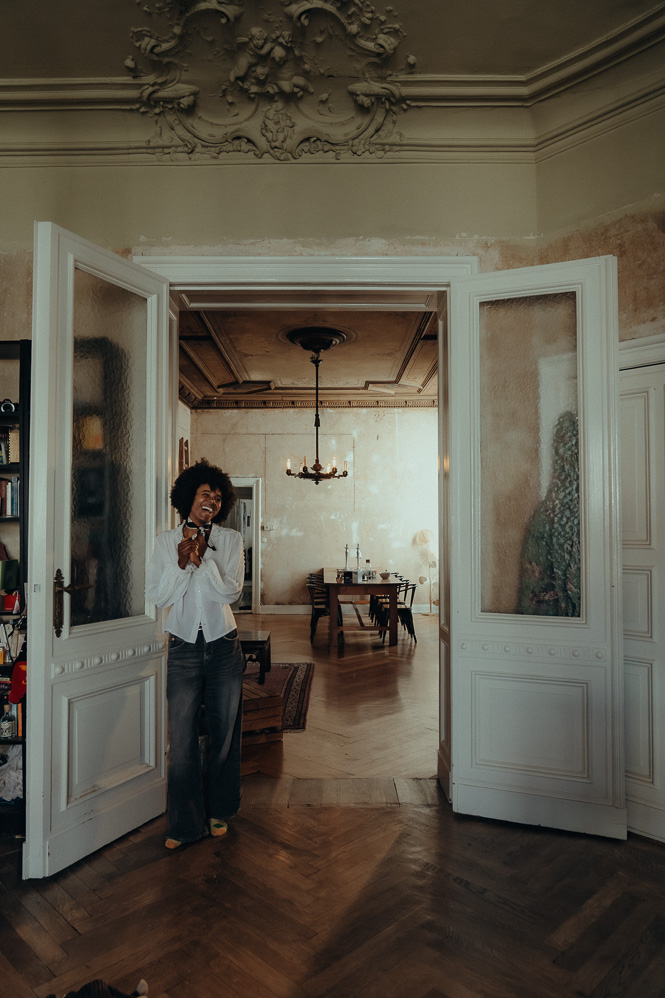
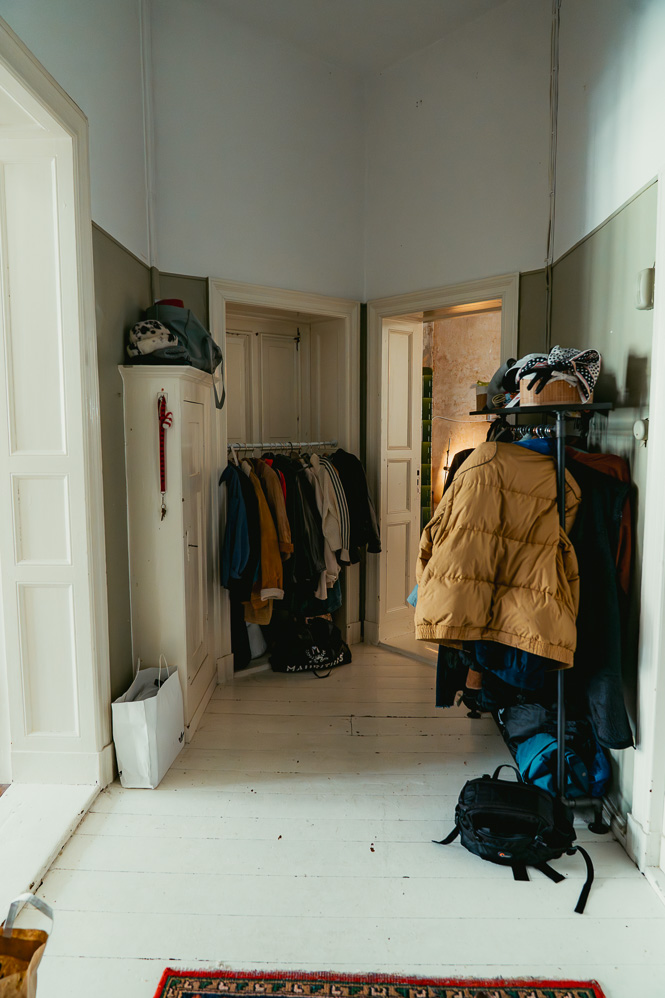
Stepping into the Charlottenburg Altbau flat of Berlin-based rapper Sorvina Carr, we’re greeted by a symphony of warm welcomes and excited dog barking. The high ceilings and wooden floors feel lived-in, telling stories of their own – a comfortable extension of the vibrant energy Sorvina brings to the stage. With her dog at her heels, Sorvina opens up about a career that wasn’t a calculated choice, but a life that found her. Her journey is a testament to embracing spontaneity, moving beyond the “X-factor” narrative, and finding her true voice in a city that welcomed her with open arms. We talked to Sorvina about the power of protest in her identity as a queer Black woman, the value of a homecooked meal, and why she’s a “phenomenal imposter.”
FvF
Tell us about the first time you realized that you wanted to become a musician, and what impact your career has had on you as a person.
Sorvina Carr
I didn’t make the decision – the decision found me. Music always brought me so much joy and I always felt I could express so much through music, but I think I somehow subscribed to this very wrong narrative that to be a professional musician is something that is reserved for an X factor sort of persona. I didn’t see myself as fitting into that category. As I went through life, music naturally found me: It’s how I love to connect with people. So I woke up one day and asked myself “Wait, am I pursuing music?”, I needed some time to realize that that’s what was happening.
In my life I’ve had a lot of wacky jobs – things to make money and get by. For a long time I had no idea how I wanted to spend my life, so I would go into work and maybe do a half-ass job because it wasn’t my passion. Music somehow brings passion and making money together and it’s beautiful, but also very dangerous, as I have to stay grounded in the idea that I was a very happy, whole and complete person before I ever even touched a microphone. I have to make sure that if ever I experience a time period where my career is hitting a low, that I don’t perceive that as who I am. Ultimately, “Sovina the person” is someone who has always loved spontaneity and all the different blank canvases that life can bring.
FvF
What role does Berlin play in your musical development?
Sorvina Carr
I’ve always loved rap music, but I never considered it a reality that I could be a rapper. At school back in the US I actually rapped and freestyled, but I always hid behind the guise of just messing around. When I moved to Berlin – from the moment I stepped off the plane – I was in the right place at the right time, and that led me to being in the presence of other rappers, soul, R&B, and other musicians and artists. I fell into the arms of the “A Song for You” community just three months after moving to Berlin, and that completely changed my life. Then, it was one footstep at a time, finding my sound and who I am. That ended up being hip hop.
“No matter how hard we may try, music cannot happen in a vacuum.”
FvF
Your voice – as your primary creative instrument – is fundamental to your music. How does this reality intersect with everyday tasks? Are you ever mindful or hesitant when engaging in activities that might impact your voice? Is there a strange duality in knowing your primary creative vessel can both achieve profound musical expression and perform mundane daily functions?
Sorvina Carr
Sometimes I am definitely a little superstitious about the way that I use my voice. I try to speak and breathe honesty, enthusiasm and authenticity into what I’m doing. When I am using my voice in ways that are not aligned with the feeling that I try to create when I’m on a stage, it is somehow working against each other.
I had to confront my gossiping habit years ago. How could you go through life speaking into the world things that are not full of love and compassion, and then expect to do that authentically on a stage? I’m very careful with what comes from my mouth. I don’t always make the mark, for sure, but it’s always in the back of my head.
FvF
Creative work in music, especially at a high level with songwriting, recording, touring, and live performances, can often involve periods of intense focus, isolation, or travel. How do you actively cultivate and maintain meaningful connections and friendships amidst these demanding creative rhythms?
Sorvina Carr
I think one of the most special components about music as a career is that no matter how hard we may try, it cannot happen in a vacuum. Everything that I am and everything that I do depends on the faith and the trust that I can put in other people to also bring their strengths, their talents and their energy. So when I’m having an intense period of touring, I am away from the people, the systems and the love that I have on a more normal, daily basis, but I’m on the road with my band and meeting new people in every city who also just love that act of creative expression. I’m a super extroverted person and my entire life has been a lot of ebbing and flowing and moving around. So in the absence of the meaningful connections that I already have, I have no choice but to just make more. And then suddenly I feel like I have friends everywhere in the world. That is what keeps me fed, socially and communally.
FvF
Do you have any particular routines to kind of protect your precious time from digital distractions?
Sorvina Carr
Yes. This is particularly important while touring, as so much of the time is spent in transit, and it’s so easy to just pass the time on my phone. The first month that I spent touring my screen time report came back with numbers I was not proud of. I’m trying to just stay conscious and suppress that kind of subconscious urge to pick up my phone, so I always keep a book nearby. All of a sudden, this time on the road is time that I spend enriching myself and my brain.
The book I have with me on tour at the moment is barely a book because it’s like totally falling apart at the seams. It’s called “A New Earth” by Eckhart Tolle – a book that I always come back to, to keep me grounded. One of my favorite fun facts: Eckhart Tolle – who is this really normal looking, older German guy – is featured on Kendrick Lamar’s album “Mr. Morale & the Big Steppers”. It’s crazy as I have been a fan of his for a really long time. There are these moments sometimes where an artist drops something – whether it’s an album, a movie, or something else – and you feel like “oh my God, this was for me”. That’s what happened here. Kendrick Lamar is my biggest inspiration – he’s not only a rapper, but a visual artist, storyteller, and figure of protest. I spend a lot of time studying him – super formative in regards to who I want to be as an artist and as a person. So when Kendrick Lamar released this album, and I heard this voice that sounded awfully familiar – Eckhart Tolle – who apparently developed a very mentor-like relationship for Kendrick Lamar during that time – it was a huge synchronicity for me.
“I love to come home and my partner has prepared a special meal for us to enjoy together.”
FvF
You’ve just completed a significant creative project—perhaps finished recording an album, launched a new single, concluded a demanding performance run, or wrapped up a major songwriting phase. The intense focus shifts, the energy begins to fade. What’s the very first, truly mundane, simple thing you crave in that post-creative space?
Sorvina Carr
That’s easy: A homecooked meal. I’m a very simple consumer of food and like when there’s just rice, vegetables and some sort of protein. This gives a lot of regeneration to my body and soul. I love to come home and my partner has prepared a special meal for us to enjoy together. I am really grateful for those moments.
FvF
What, when you’re not actively engaged in your music or songwriting – what is the soundscape of your home mostly?
Sorvina Carr
This is a super interesting question. For many years in my life, I was really proud of the amount of music that I listened to and somehow felt this competitiveness that the minutes that I spent listening to music was always more than than my friends in my Spotify Wrapped at the end of the year. I think it was in 2021 where I got my Spotify Wrapped and it was crazy: I had listened to 200,000 minutes of music that year, and when I did the math, it broke down to eight hours of music per day or something crazy like that. That was the first year that this veil kind of broke. And it was from that year forward that I actually created an intentional goal for me to have more silence in my life and in my home. It was really interesting when the silence kind of replaced where the music used to be, to observe the things that were happening in my head and in my heart.
Silence is definitely something that I intentionally strive for as the soundscape of my home. And even beyond that, when I can achieve a silence of my mind: That is the home I would like to live in. I have been blessed with the presence of a very chatty dog who loves to speak his mind. He barks in this special frequency that is very intense, but I got used to it, and I’ve learned to love it because it tells me that he’s home and around.
“Silence of my mind: That is the home I would like to live in”
FvF
Is there any other sensory input that you seek?
Sorvina Carr
I am a huge, huge fan of incense. The sensory experience of having a very beautiful smell around you. I light incense almost every day and it somehow creates this psychological effect that it really brings me down to earth. I love what I call the “Vabali smell” – I believe they burn Nag Champa. I adore that scent and associate it with very deep relaxation and introspection.
FvF
What is one object in your home that is absolutely essential to your well-being?
Sorvina Carr
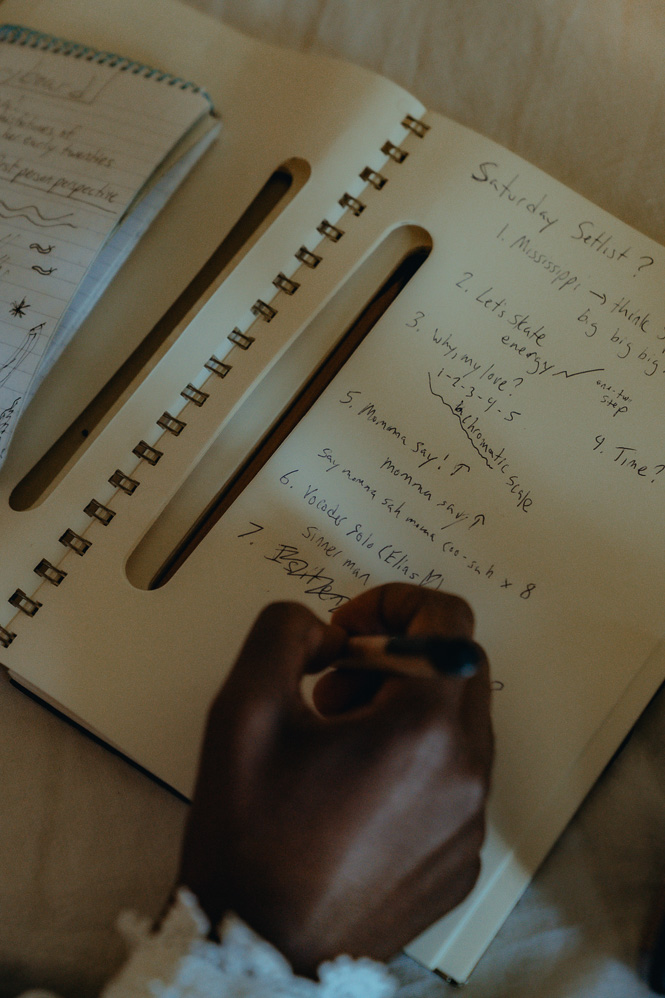
Absolutely essential for my wellbeing is for sure my notebook, or I should say notebooks actually. I at least try to start my day with three pages of just a stream of consciousness, getting everything out of my head to the best of my ability. It’s so cool because I’ve been journaling since I was a teenager, but I never managed to make my way through a full diary or through a full journal, but I actually developed this practice from a really special book called “The Artist’s Way”. I really changed when I started to engage with this daily practice, and I think this happens to many people. Now I’m finally finishing my journals.
One of the most important pieces of advice I’ve ever been given within the context of rap music: If you really want to be great, you should always, at any given moment of your life, have the resources and availability to write something down immediately. I’m trying to stay off of my phone as much as I can, and while I was traveling earlier this year, I found this perfect little notebook, and I call it my notebook of spontaneous and grand ideas. My biggest challenge within this concept is that I often don’t give any context. So when I’m looking through the notebook, I often have difficulty understanding what I actually meant. In this notebook I’m concepting and dreaming of set lists and new lyric ideas, concert ideas, set designs, all kinds of little things. And I just hope to God that I never accidentally leave it behind on a plan or train seat or something. Whoever finds it will be very successful (smiling).
“I’m very careful with what comes from my mouth”
FvF
Do you have any specific practices that help you bring all the pieces in your notebook together and create, let’s say, an entire track?
Sorvina Carr
I really resonate with and carry the kind of cultural practice of storytelling that exists so much in Black American identity. Whenever I create a song or a lyric, it starts from there, and then unfolds naturally. Audiences can see from my music that it is never a song with a verse one and a verse two that don’t connect together, as the entire composition creates the full picture of what I’m trying to say.
One of my favorite differences between who I was as a folk singer songwriter to who I am as a rapper, is that on average, I just say more words. I had some folk songs where the chorus was just one sentence, over and over. Whereas when I’m rapping I’m saying a hundred words a second. My internal, almost obsessive compulsive need to say a lot and talk a lot is very much satisfied with making rap music. Both genres – folk and rap – as well as other genres have always equally been a part of my life. One day, I would love to let people see my saved song catalogue as it’s all over the place. One example is my love and adoration for the banjo – a stunning, stunning instrument.
FvF
Beyond explicit statements or public discourse, does the very act of creating your music—whether it’s crafting a poignant rap verse, arranging a soulful melody, laying down a powerful beat, or performing with raw authenticity—feel like an act of resistance, affirmation, or an essential contribution in itself? In a world of noise and complexity, is the integrity or beauty of your musical expression a statement in its own right?
Sorvina Carr
Yes! I exist in this world as a queer black woman and every story that I tell is born from that identity. Identity is contextual: I have traveled all over Europe, bringing my music, my presence and my stories to different stages. Sometimes I’m on a stage and suddenly in the back of my head I remember “Oh, wow. Am I about to share this very queer story in the middle of Hungary or the German countryside, or wherever, outside of my comfort zone?” My background is in sociology – that’s what I studied. I am constantly fascinated by different sociological concepts, and one of the most interesting ideas regarding queer theory is that there is actually no such thing as being out of the closet – just that the closet changes in shape and size depending on where you are. I could say right now here in this room: “ I am a queer person”. But am I out of the closet in the sense that now everyone in the world knows that I’m a queer person? Of course not. So within that sociological notion, I can feel – depending on where I am in this world – that my closet is growing bigger or smaller or more comfortable or more cramped.
In pursuit of authenticity and the spirit of hip hop – which is protest and resistance – I am constantly faced with that challenge of existing in whatever closet that may be and still making the decision to step outside of it. Even in the moments where it felt rather challenging. And every single time without fail, I have someone DM me saying ”Hey, I was at your concert last night, and as a queer person, things are really hard here at the moment, but thank you for bringing the story to the stage. I felt seen and could relate”. For that reason, I will continue to be honest about who I am and what that looks like. If that’s not the definition of resistance, I don’t know what is.
FvF
Both your rigorous creative practice as a musician and your public engagement through performance require immense strength, conviction, and emotional honesty. So where do you allow yourself to be vulnerable within your creative process or life?
Sorvina Carr
Vulnerability is one of those really holistic topics. The question is like, where does the vulnerability start? Does it start on stage or does it start in the studio, or does it just start from my bed when I wake up in the morning? Somehow, if vulnerability is introduced somewhere in the process, every step after, will always carry that little seed with it. When I think of the people that I am most inspired by, the music is completely inseparable from the act of being vulnerable. One of the reasons why Kendrick Lamar’s “Mr. Morrell & the Big Steppers” might be one of my favorite projects of his ever is because he’s talking about therapy, how lost he felt and the answers that he went looking for. The way that I feel when I listen to that album is the way that I want people to feel when they listen to me. I challenge myself to be as vulnerable as I can be, even if it’s in a super public context of releasing music or of being on a stage.
FvF
You’ve likely mastered significant technical and conceptual challenges in your field of music, from songwriting to performance, and rapping. What, in a purely artistic or technical sense, still genuinely challenges or even ‘scares’ you?
Sorvina Carr
I am so camera shy, so doing interviews still scares me (smiling). Anytime I’m at a festival or in a situation where I have to take photos or do portraits, I am afraid that I suddenly forget how to be myself. I feel in the current state of music and art there is this pressure to be really “Cool”, and that’s not me. I’m really not that person. Sometimes after concerts people will come up and ask to take photos and it’s so funny ’cause when I look back on the photos – whether they post them on Instagram or they just show me in the moment – I’m always just standing there like it’s picture day in elementary school. That’s who I am. I’m not this really cool type of person. I’m really goofy, and still learning how to just be myself and be comfortable in showing myself in front of a camera.
FvF
You’re a phenomenal imposter.
Sorvina Carr
It’s one of my greatest strengths actually – being a phenomenal imposter. It’s how I made it through all those wacky jobs.
“I can feel in some way that I’m able to live out my pastoral dreams through music.”
FvF
The integration of artificial intelligence into creative workflows is rapidly redefining paradigms of artistic production. How do you currently perceive and actively engage with AI tools within your own musical process?
Sorvina Carr
Under that umbrella idea of AI, I try to roll with the punches of human evolution. AI and generative forms of intelligence are very much a part of the human experience at the moment. I try not to resist that too much – at least in a way that would create resentment or spite. Resentment or spite are never a positive thing for a human being to experience.
I express massive gratitude to ChatGPT for all of the artist bios, press releases and grant writing that it has helped me do. I haven’t necessarily brought AI into my creative processes – at least not yet – as the music that I create and the stories that I tell are very much my own. No one in this world – human or non-human – could ever know me better than myself. So I leave that responsibility in my own hands.
It would be amazing, though, to find some sort of AI system that can tell me what I need to urgently get done. That’s kind of where the human side of me fails a little bit. Paperwork.
FvF
If you could have a conversation with any creative figure, living or dead, from your own or another discipline, but the one rule was you could not talk about their specific artistic output, who would you choose and what would you talk about?
Sorvina Carr
As naive as it may be, I think all of us as human beings have some sort of celebrity that we just feel that we would be friends with. Of course you don’t really know that person, but you just have this hunch. For a long time now I have always had the feeling that me and Maggie Rogers would have a lot to talk about. From what I just read about her, she also has a very strong connection to spirituality. And she has done something that is also kind of a bucket list item to me: She got a degree from Harvard Divinity School. My family always said from when I was very young: “you have a little bit of a pastor in you”. I can feel in some way that I’m able to live out my pastoral dreams through music. The opportunity to sit down and study the nuances and the theory of spirituality as Maggie Rogers has done is something that I hope I can do at some point in my life and I would love to talk to her about.
FvF
This is a bit abstract, but if your home could tell one truth about you that your audience or collaborators never get to see, what would it say?
Sorvina Carr
Wow. I’m going to give you a really, really honest answer. Especially in this period that I’m in right now where my work takes so much energy and where my public life involves so much energetic output, my home would say that I am really not living very far away from the experience of a teenage boy. I’m sleeping at any chance I get and I’m eating whatever garbage is lying around the fridge and the pantry, and I’m living in boxer briefs and t-shirts all the time, as that’s just the regeneration that I need at the moment. You should consider yourself lucky that you haven’t had to actually see it. It’s very frightening to see me in my boxer briefs.
Firmly rooted in the vibrant landscape of hip-hop, Sorvina Carr is a New York-born, Berlin-based artist with an infectious love for storytelling. With live instruments & performance at the center of her sonic identity, Sorvina’s music lies somewhere at the intersection between jazz Rap, neo-soul, alternative hip-hop, and gospel.