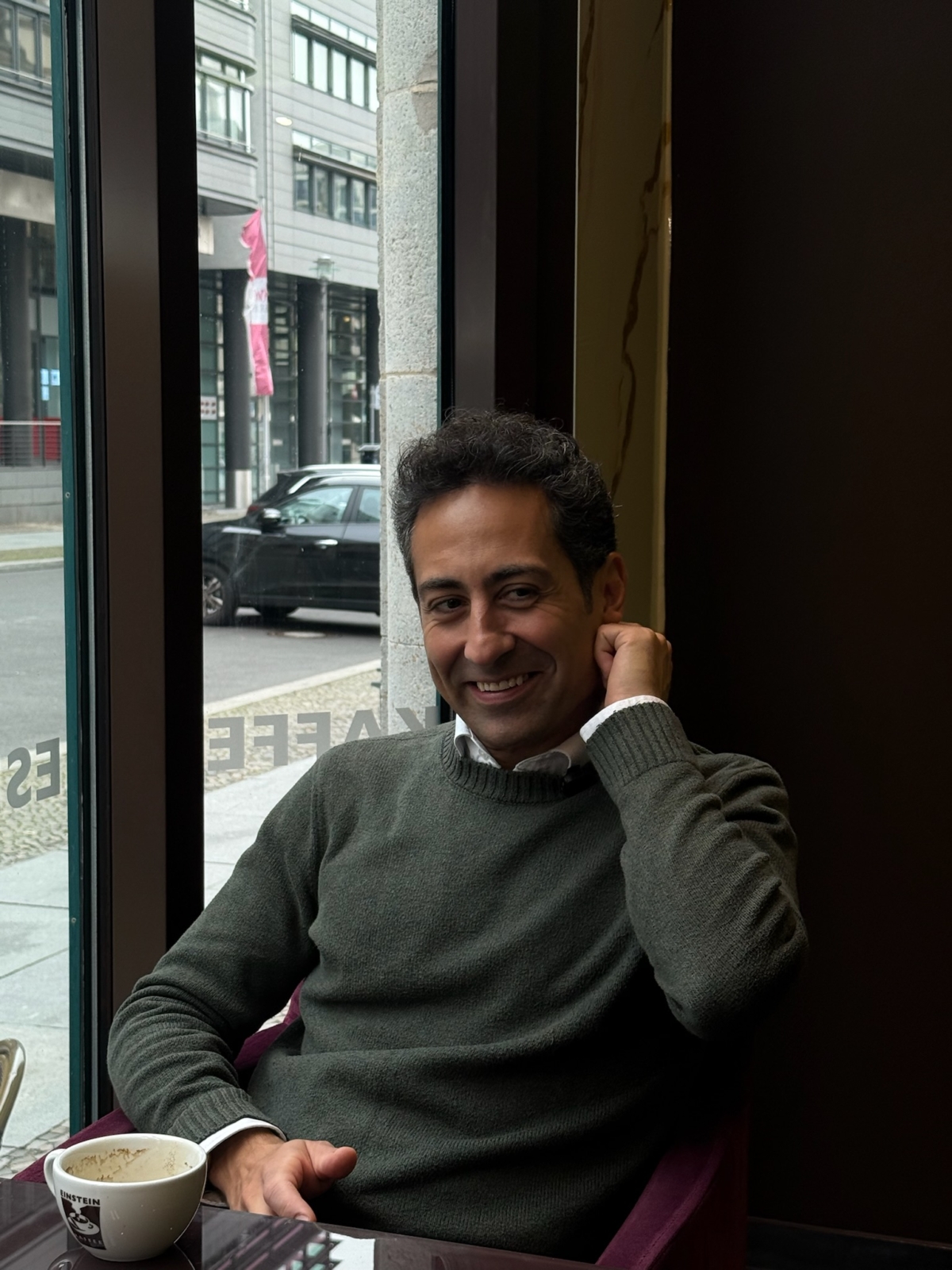
Nabil Shehata has learned Arabic twice. The first time as a child in Kuwait, where he was born to an Egyptian father and a German mother. The second time after school in a small village near Bremen, across the table from his father, because a year with his German grandmother had wiped out the first attempt completely.
As a boy, he heard a bass line and decided that nothing else would do. Not the cello. Bass or nothing. The bass took him to the Staatskapelle Berlin and then to the Berlin Philharmonic as principal double bassist. Along the way, there was Daniel Barenboim. “How can you say no to him?” Nabil asks, recalling the summer the world-renowned pianist and conductor talked him out of practicing at home and into the West-Eastern Divan Orchestra. Nearly a decade with the Divan gave him friends for life. Today, he stands on the podium, shaping clear phrases together with the musicians in front of him.


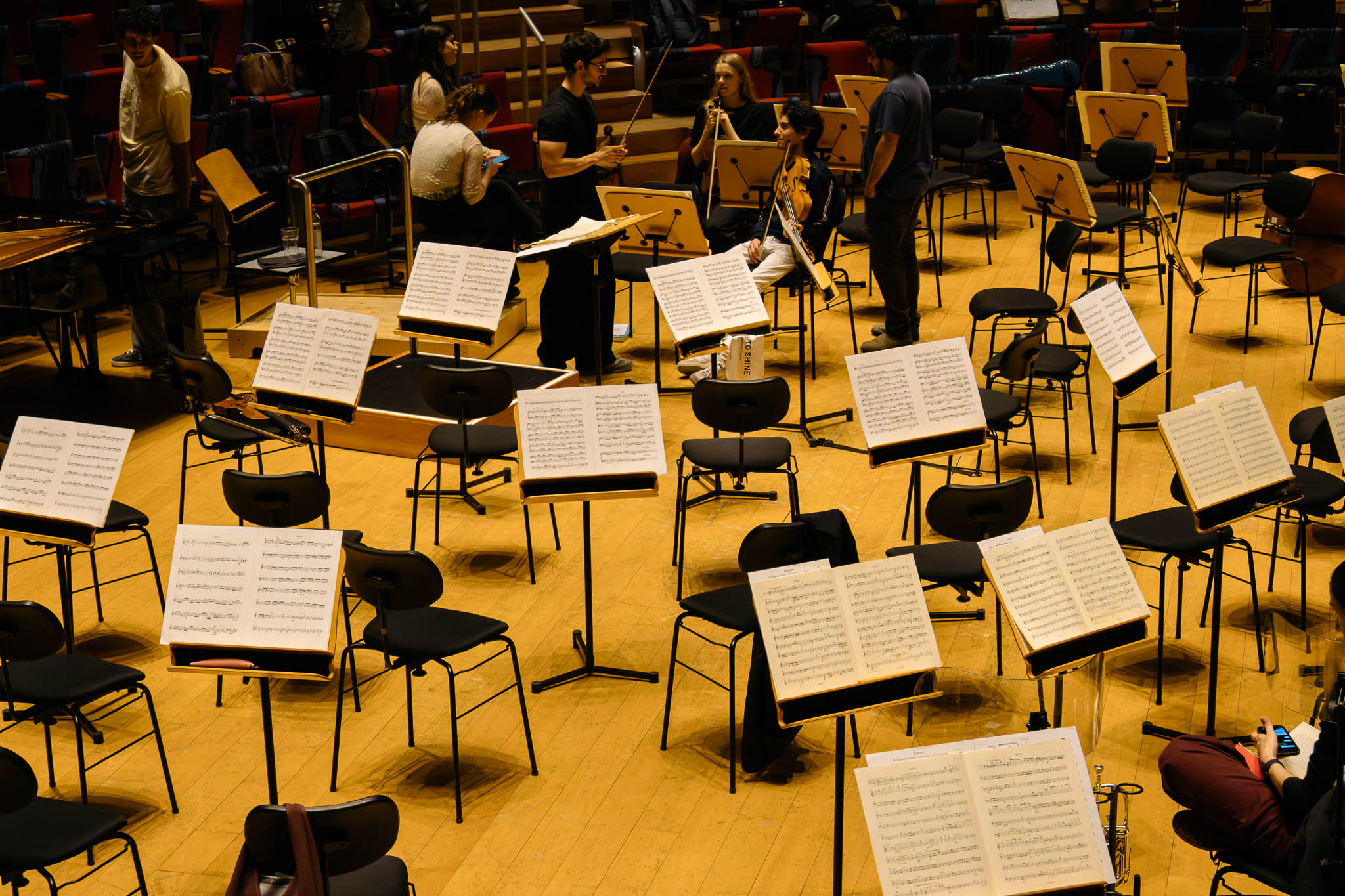
As autumn settles over Berlin, we cross Gendarmenmarkt and follow Nabil into the Pierre Boulez Saal, where he is preparing for the West-Eastern Divan Festival, a week that brings together, for the first time, everything that grew out of Daniel Barenboim and Edward Said’s work.
The multi-venue music festival in Berlin is presented by the Daniel Barenboim Stiftung and builds on the legacy of the West-Eastern Divan Orchestra which was founded in summer 1999 by the two lifelong friends Daniel Barenboim and Edward W. Said, the prominent Palestinian-American literary theorist and cultural critic, to bring young musicians from Israel and Palestine together. The foundational message of dialogue and understanding travelled the world, and rooted in connected and related projects across the globe.
This year’s inaugural West-Eastern Divan Festival gathers all of these institutions under one roof of sound and weaves them into Berlin’s diverse cultural fabric. Over the course of a week, eleven concerts and events unfold at venues across the city, with internationally celebrated artists, long devoted to the ideas and missions of the Divan, joined by students and distinguished guests. The festival opens with Daniel Barenboim conducting the West-Eastern Divan Orchestra at the Philharmonie Berlin twenty years after their first performance at the venue in August 2006.
-
FvF
Nabil, you started out as a bass player.
NabilOh, I’m still a bass player. (smiling)


-
FvF
Of course. But these days, you’re mostly the one leading.
NabilYes, very much indeed. The bass has truly become my luxury. I can choose when I play and who I play with. Many of my friends from the orchestra, youth orchestra and master classes now have their own festivals. So once a year I go to all of them, maybe six, and play chamber music on the bass.
It’s wonderful, and it’s healing. We’ve been playing together for 20 years, so we hardly need to rehearse. I feel very lucky and grateful to have this in my life.


-
FvF
Before all that, where did you grow up?
NabilIn Verden an der Aller, a small town near Bremen. Well, actually in a small village next to Verden, until I was 14. But I was born in Kuwait.
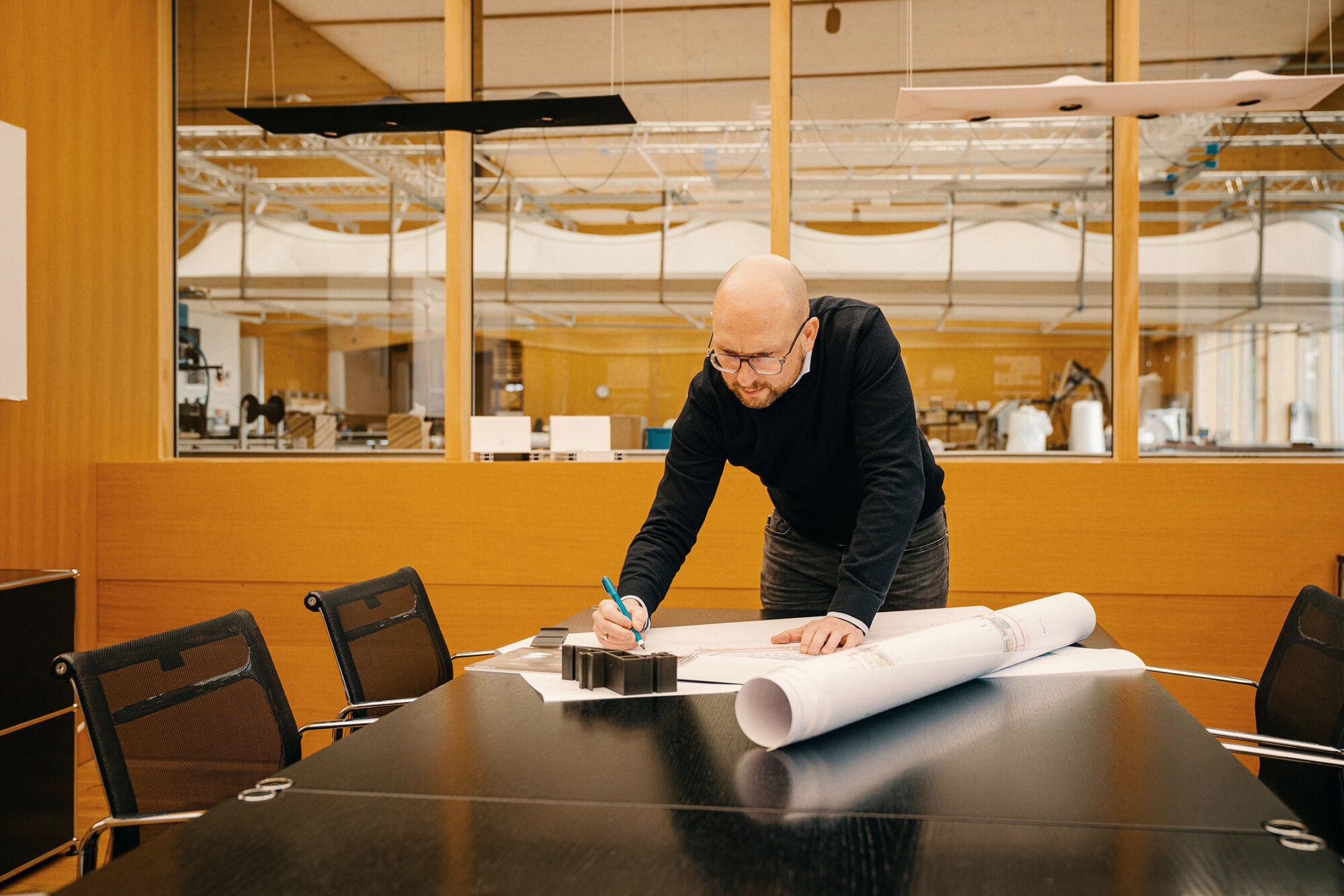
My father is from Egypt, my mother from Hamburg. They met in Paris. The City of Love, of course. My father was an architect, first in Cairo, then in Kuwait, where many Egyptians went for better jobs. After 12 years abroad, my mother said, “I want to live in Germany, too.” So we moved.
My father still had to finish his work, so my brother and I stayed with our German grandmother. We had never met her before. We only spoke Arabic, and she didn’t. So we learned German, and unlearned Arabic. And somehow, we made it work. I later had to learn Arabic again, this time with the help of my father.

-
FvF
And in that German village, you chose the double bass, which isn’t the most obvious choice for a child. I imagine your mother tried to talk you into the cello.
NabilExactly. There was no bass anywhere. My mother, who is also a musician and worked as a teacher, told me I had to choose an instrument besides the piano. All of us, her children, learned an instrument. Around then I heard some music, maybe from a musical. It ended with something sad, with pizzicato on the bass. It was actually an electric bass, but I didn’t know that. I wanted to play exactly that bass line.
My mother asked, “Why not the cello?” A cello was much easier to find. And she couldn’t find a bass teacher either, so she asked again. But you can’t play those pizzicatos on the cello, and that was the only reason I wanted an instrument. I was stubborn. (laughing)
It took her half a year to find a small bass and a teacher. Of course, I didn’t expect to use the bow so much. I just wanted to do the pizzicato thing. But I stuck with it.


-
FvF
Fast forward to 2003. How did you end up in the West-Eastern Divan Orchestra?
NabilIt started with Daniel Barenboim. I had just gotten a job at the Staatskapelle, but he wasn’t at my audition, so I still had to play for him on the orchestra’s last tour of the season, in Spain.
After I played, he came backstage and we started talking. He learned that my father is Egyptian and told me about the West-Eastern Divan Orchestra, that now brings together an equal number of Israeli, Palestinian and Arab musicians, alongside members from Turkey, Iran and Spain. It wasn’t as famous then as it is now, so I had no idea what it was. But he said, “You have to come.”
Their tour started right after ours and lasted six more weeks. I told him I had the ARD competition in September and needed to practice at home. He asked, “Do you REALLY want to practice the whole summer alone at home?” I said, “Yes.” And he said, “NOOO!” (Laughing) I mean, how can you say no to him?
Then he offered to rehearse my solo repertoire with me. At the last concert in Berlin, I played Bottesini with Barenboim at the piano. I was 22 or 23. Imagine, I knew him from CDs, and now he was accompanying me. That felt really surreal and incredible at the same time.
I went to the competition still floating on that cloud. And I won.


-
FvF
So how did a bass player end up on the podium?
NabilAgain, it was Barenboim. Two years after we met, I told him I’d always dreamed of conducting. He asked, “Why didn’t you do it?” I explained that I didn’t play the piano well enough. He said, “What does piano have to do with conducting? I never studied a score at the piano.”
In Germany, you have to. He just didn’t understand. “If you want to conduct, start conducting,” he said. If he says so, I thought, then I should try. A friend of mine was organizing master classes for conductors. I asked if I could take part, and he gave me my chance.
-
FvF
And all this time, you kept coming back to the West-Eastern Divan Orchestra.
NabilEvery summer, for almost ten years. Many of the musicians from back then still play. Others stepped away for families and jobs. But now their children have grown up, and they’re coming back. You see people you haven’t seen for 15 years. It feels like a family reunion.

-
FvF
And now there’s the West-Eastern Divan Festival. What makes it special?
NabilEveryone knows the Divan Orchestra, but Barenboim started so much more: a foundation in Spain, the kindergarten and music school in Ramallah, the academy in Berlin. It’s the first time all of Barenboim’s children, let’s say, meet in one place for a whole week. Musicians are coming from Ramallah and from Spain. Chamber musicians who are too busy for the Divan now are coming back. I’m very curious to see what kind of energy comes out of that week.


-
FvF
There’s Beethoven on your program, which always makes sense. But why the Triple Concerto?
NabilIt has three soloists, so we can invite people who have been with us for a long time: Mohamed Hiber, Astrig Siranossian and Nathalia Milstein. Nathalia studied with us at the academy. Astrig has been in the Divan forever. Mohamed joined when he was 14 or 15, and he’s around 30 now. He’s also the concertmaster when Michael Barenboim isn’t there. So it stays in the family.


-
FvF
You work a lot with young musicians. How has the younger generation changed?
NabilI love working with young people. But they scroll through 30-second videos on their phones all day, and they stop looking for the story in the music, the phrasing. So I tell my students, “Sit down, put on a good recording, and listen from beginning to end.” That’s how you understand how a piece is built.
I could say, this is the new world. Life is faster now. But I don’t want to give that up. It’s a beautiful tradition that has lasted for centuries. We should show the younger generation that music is more than a clip.


-
FvF
So who actually gets the jobs? Is it simply the best players, or does it come down to something else?
NabilIt’s like in every other job. You need connections. Recently I told the new students, “Go out there and play. If someone asks you to play, play. Don’t ask about the money. Get to know people.” You’re already building your career now. If people have played with you, they’ll call you again. There are so many good players. Practicing hard and winning an audition isn’t enough on its own.


-
FvF
I read that you often have a very clear image in your head of how the music should sound. What do you want people to take with them after a concert?
NabilEvery phrase has an architecture. Where does it come from? Where does it go? Everybody hears it differently, but I want to make it easy for you to follow where I’m going. I don’t want you sitting there thinking, “Why is he doing this or that?”
It’s like going to the movies. The films I enjoy most are the ones where I never analyze what’s happening. I just get sucked in. The thinking comes afterwards. Music should be the same. I take you by the hand, you follow the line, and you listen. While we play, it should simply make sense. That’s the story, and you are inside it.