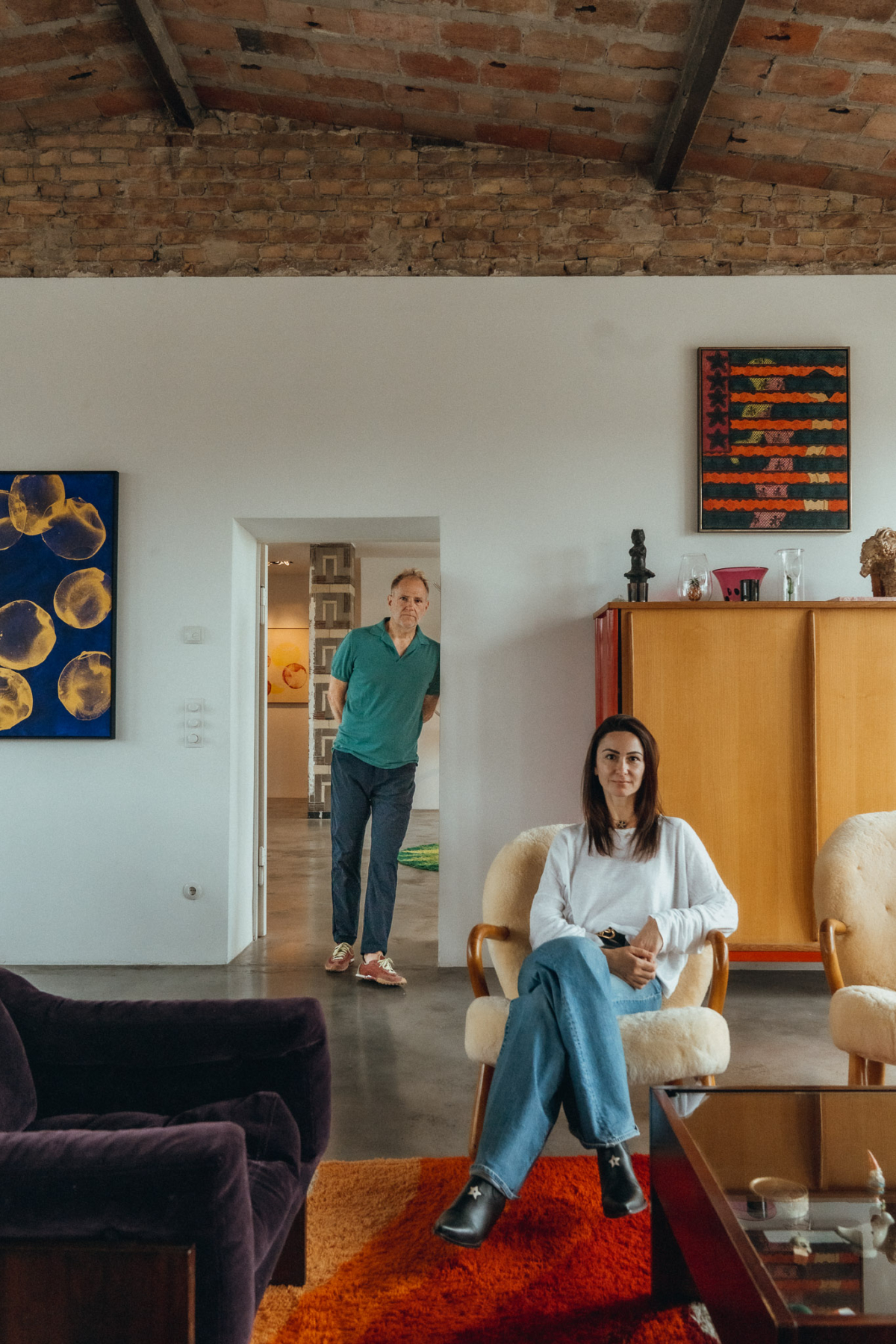
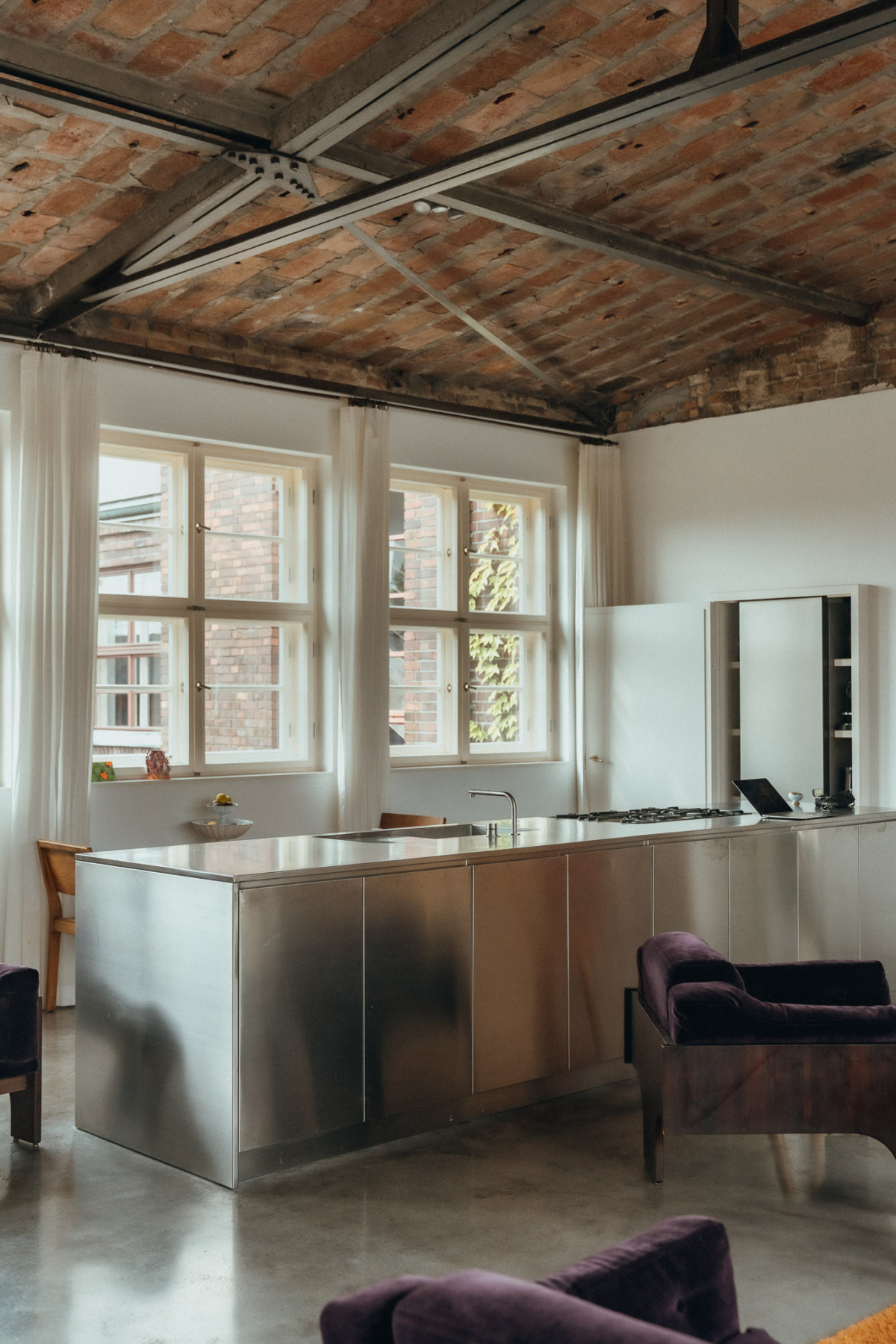
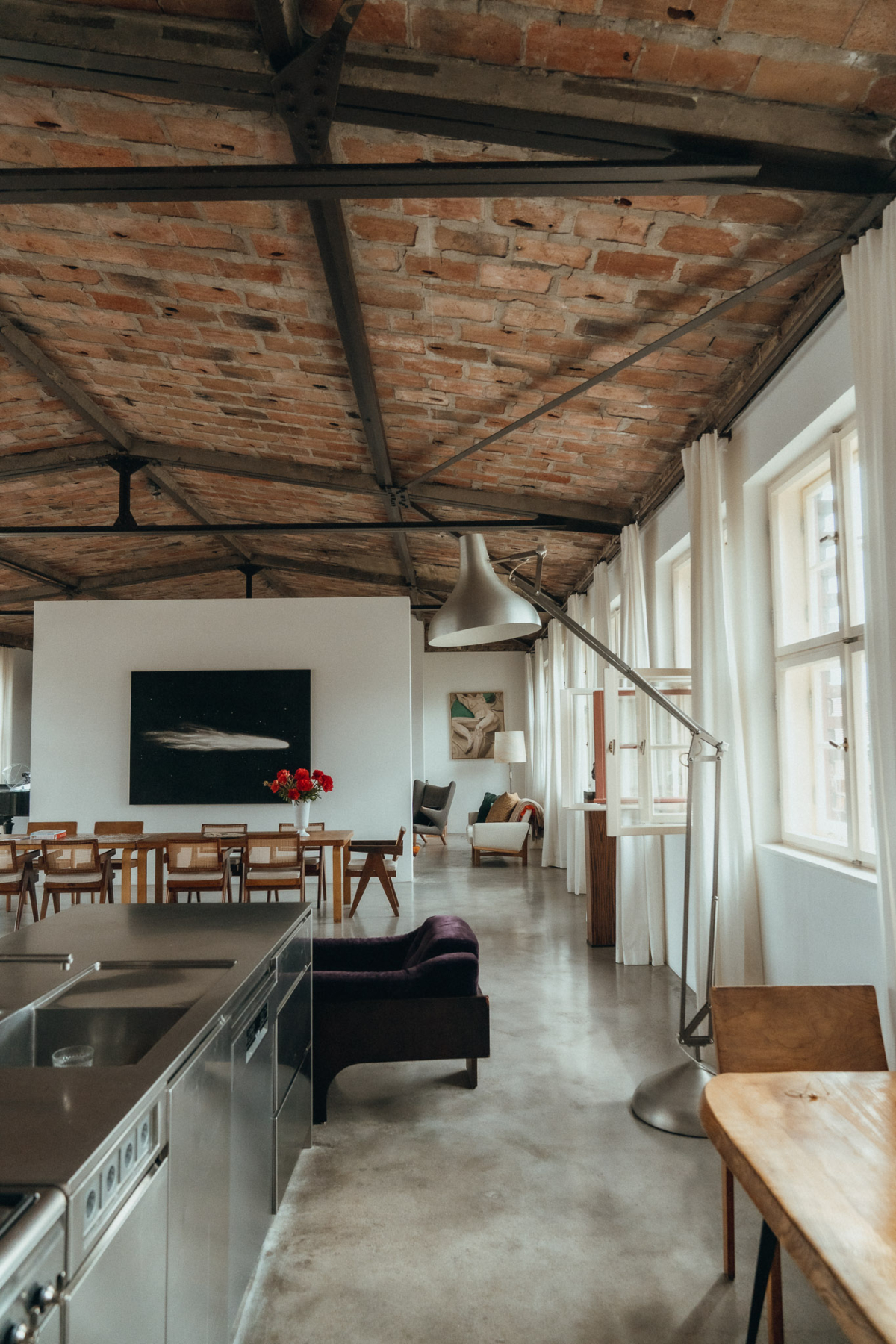
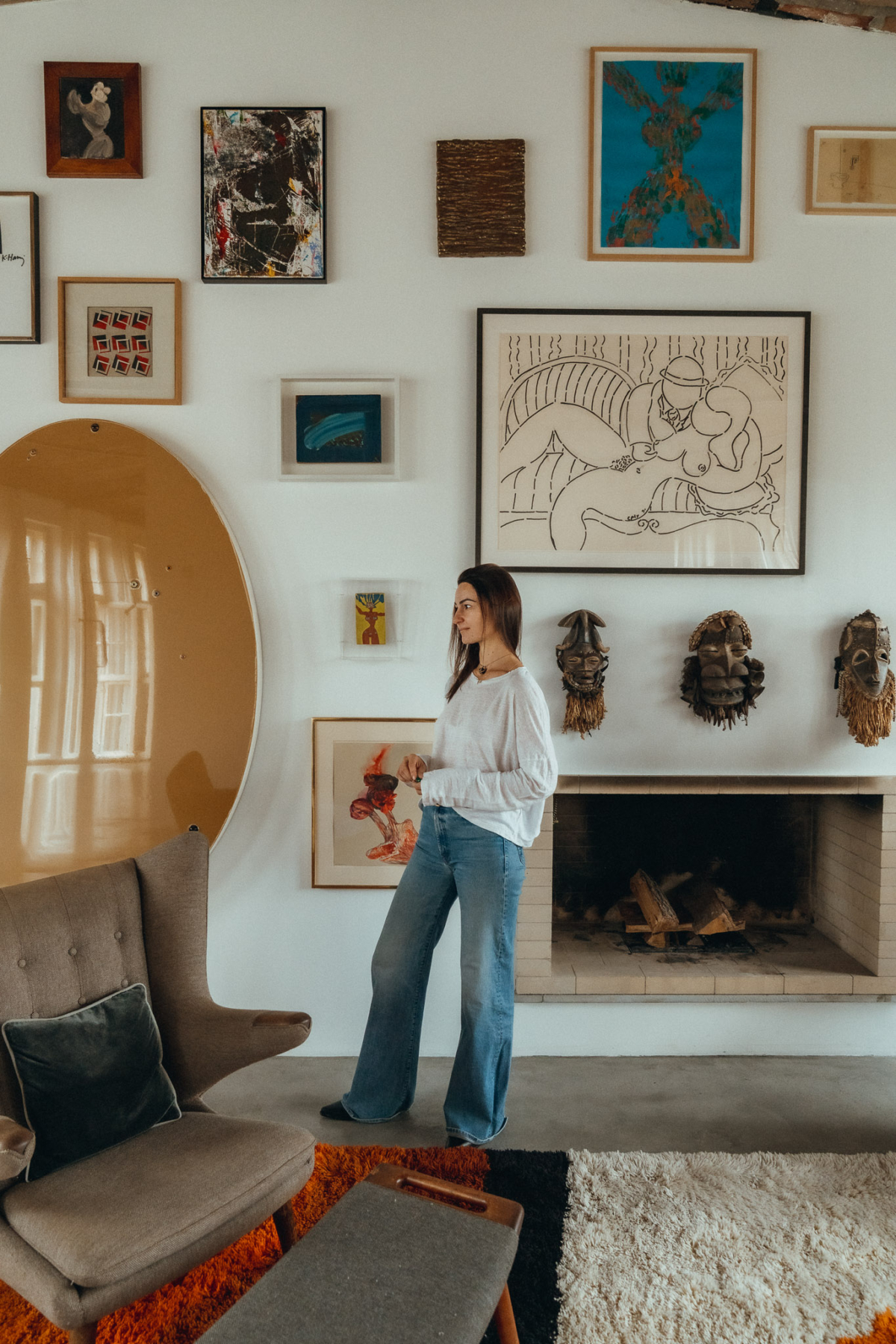
The home of Constance Breton and Michael Fuchs is made for a gregarious way of life. The art advisor-gallerist pair lives on top of the former Jüdische Mädchenschule in Mitte, a historic New Objectivity building that had stood abandoned for decades before Michael signed a three-decade lease in 2011 and fixed it up. On the ground floor is a gorgeous tiled foyer, a restaurant and Michael’s eponymous gallery. The top floor, formerly classrooms and a drawing room, is now the couple’s 450-square-meter home — most of it a vast, open-plan living room and kitchen under an exposed brick roof. This is where the couple lives, works and raises two children, ages 8 and 9, while habitually hosting vernissages and events for a hundred-plus guests.
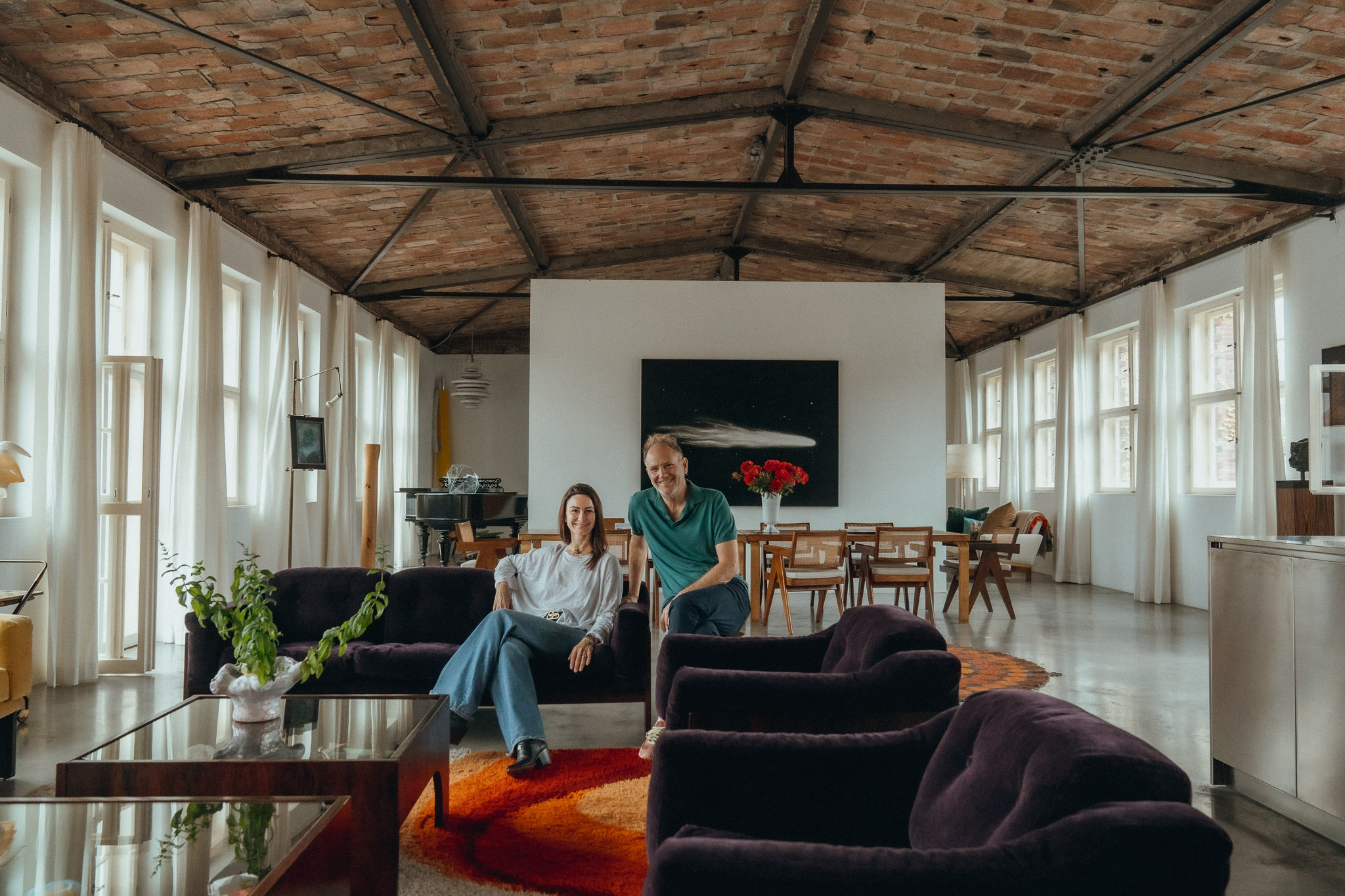
Most people draw boundaries between business and leisure, and between public and private lives. Constance and Michael see little point in that. Most of the art and furniture in their home is also for sale, from the outsized pen by Josef Albers balanced in a corner to Pierre Jeanneret’s Chandigarh chairs around the dining table. And why not? If you deal in beautiful things for a living, you might as well set an example for how to live with them.

-
FvF
Fifteen years ago, you took over a building in the middle of Berlin, and with it a construction site that demanded a lot of you. What was your life like back then?
ConstanceMichael was looking for a new kind of space to display art. He had this idea to combine hospitality and art and wanted to find a very special building in Berlin. He was looking for over a year, and then finally found the Jewish girls’ school through friends of his, and he took on the renovation project.
At the time, I was still working in New York, and he was going back and forth between Berlin and New York. He wanted to renovate as fast as possible, so literally every single day that he was in Berlin, he was on the construction site. The building was completely abandoned, almost a squat. Everything had to be redone — electricity, heating. The challenge was for him to be able to accomplish his vision, because it wasn’t like he was coming from real estate — he did everything himself. It was him fixing the pipes. He knows every detail of the building.

-
FvF
You and Michael became custodians of a scene. A restaurant opened on the ground floor and quickly gained a Michelin star. You threw some legendary parties. What was it like to be at the center of all the action?
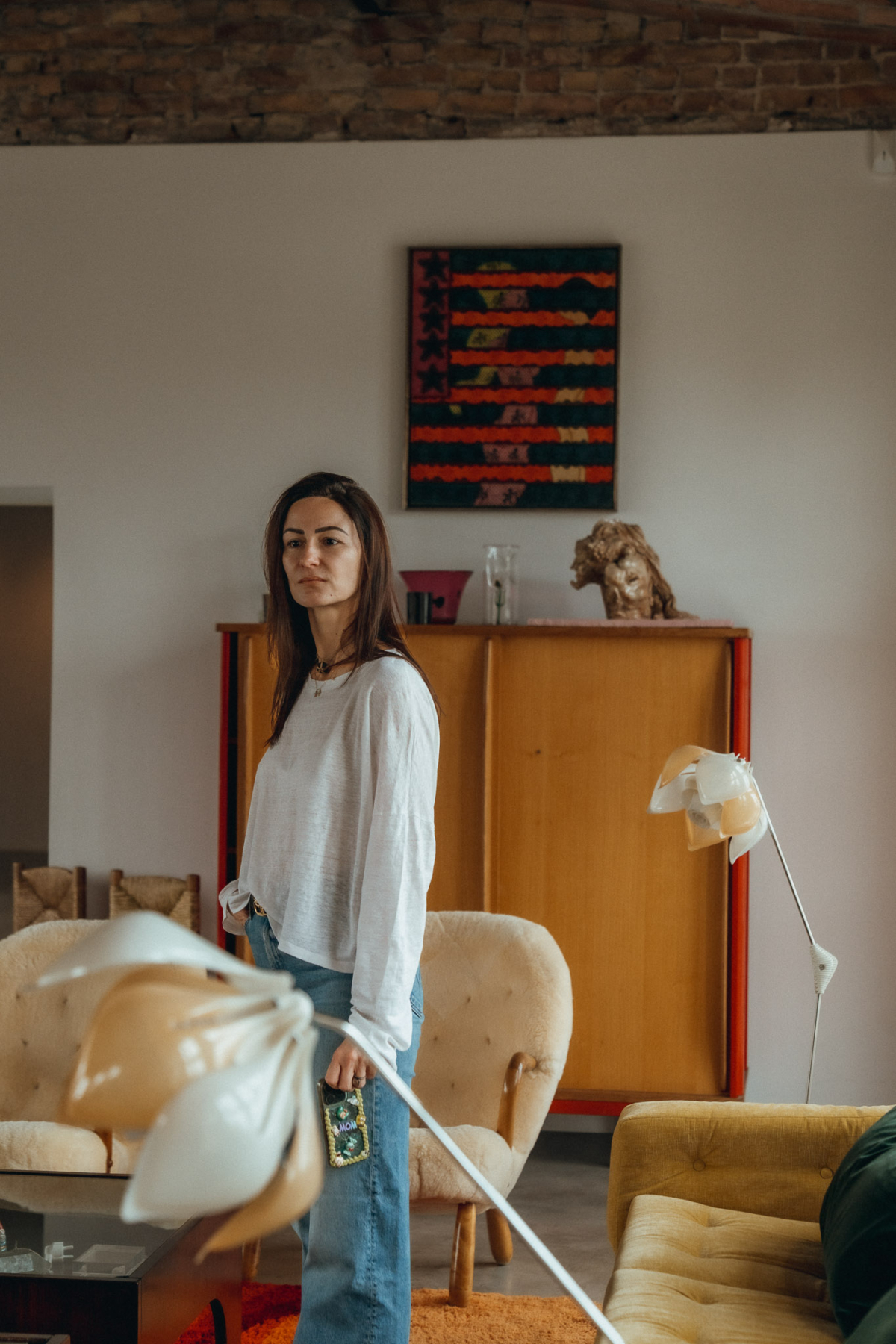
ConstanceIt was a good feeling — it brought new energy, and we were able to do everything we love, which is food, hospitality and art. It was all based on friendship: Michael opened Pauly-Saal with his best friend, Stephan [Landwehr]. Of course, we had a lot of parties because we didn’t have the kids at the time. Having kids meant that we switched when the party begins. Now, it starts early and sometimes finishes earlier, although this is not always the case.
-
FvF
What were some of the most memorable banquets that you organized?
ConstanceKarl Lagerfeld organized the party for La Petite Veste Noire, for the launch of the [Chanel] jacket. That was one of the first exclusive dinners we organized there. I would say every opening of the gallery was a memorable evening, and still is, although now we do lunch instead of dinner. We also did a party with Interview Magazine and — me being French, of course I have a soft spot — Charlotte Gainsbourg gave a private concert.
-
FvF
The apartment is set up to facilitate big events. How does one organize a house party for 150 people?
ConstanceWe clear all the furniture from the living room. We put in a few tables, and the place looks like a restaurant for a couple of hours. We keep the art. This is, of course, the advantage of having such a wide space. The add-on we made when we had kids was to build this secret library that could be closed off. We had to remember that we had two kids at some point, and that was a perfect way to lower the noise for them. It’s basically a built-in bookcase, and you push it and it opens like a door. When you close it, you block a part of the hallway. That’s where we put the kids to sleep. They love it, because it’s like having their own apartment.


-
FvF
The kids also get to have their fun — they have a private playground on the roof.
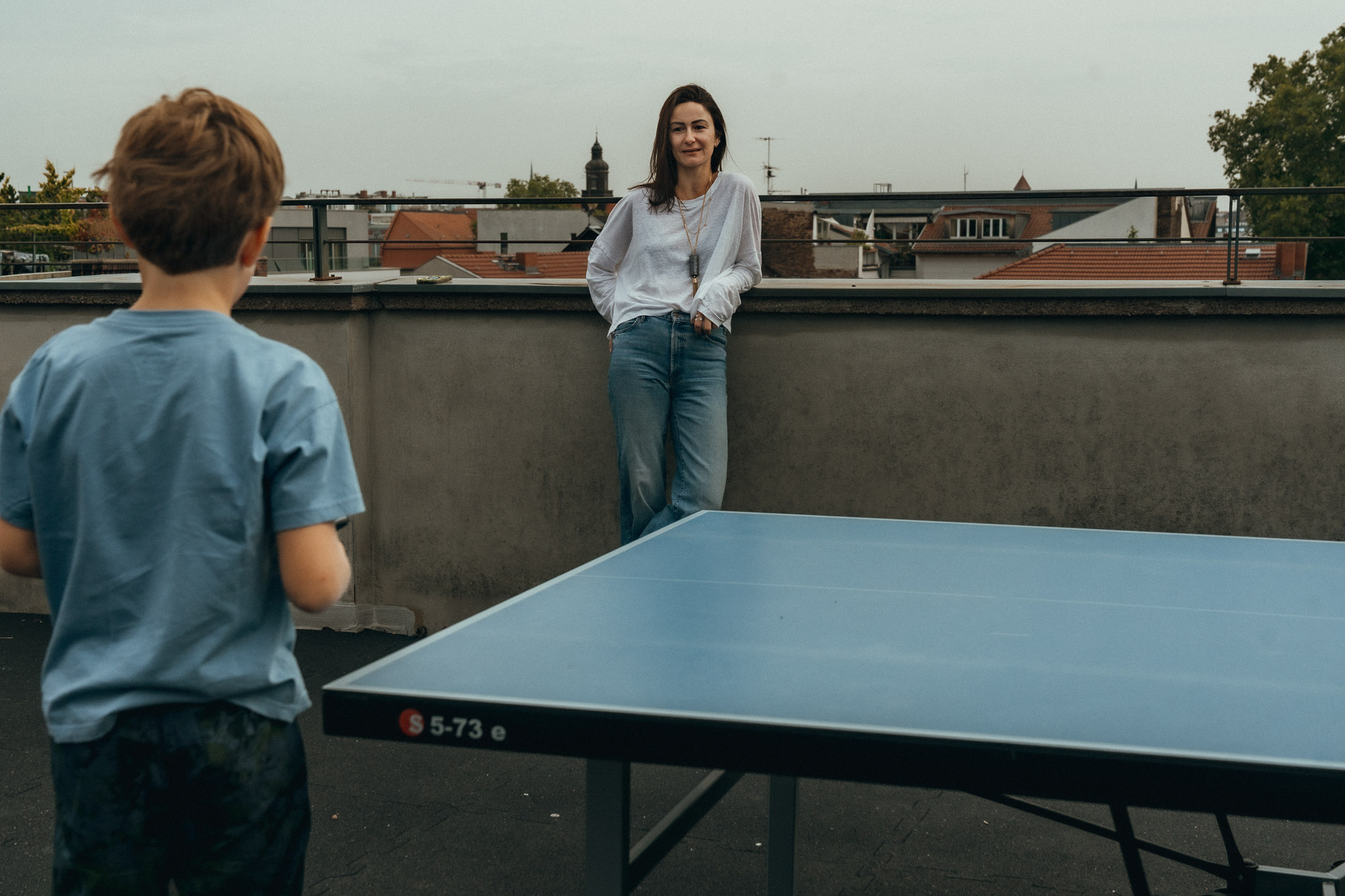
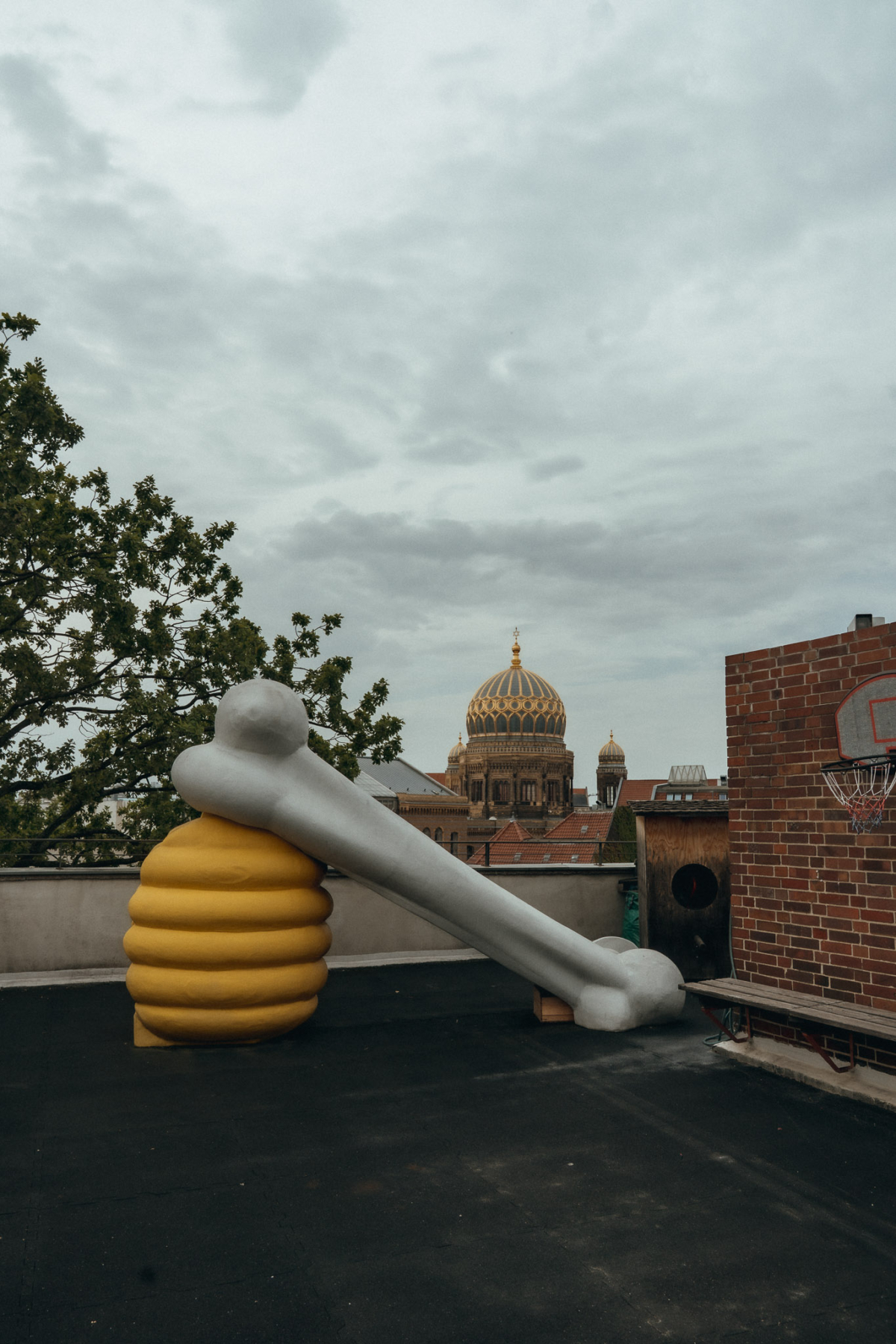
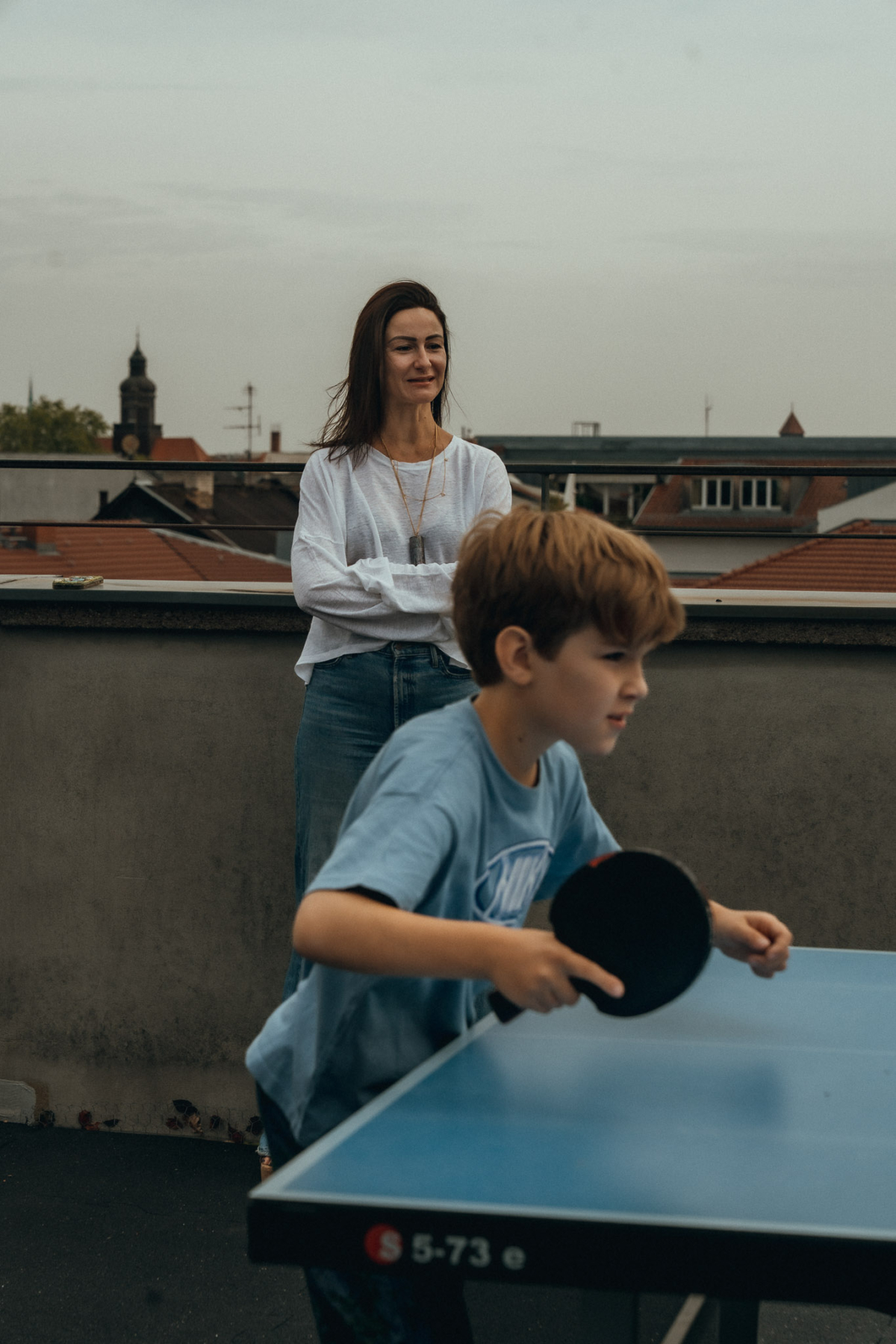
ConstanceThat is their territory. We built it in 2018, when I was pregnant with my daughter. We had this rooftop, and I was wondering for a long time what we should do with it. Being pregnant inspired us to create this playground designed by artists for children, so that they can, from a very young age, interact with art. We still open it by appointment to schools and during public openings.


-
FvF
That must have been a dream commission for the artists as well.
ConstanceWe didn’t even have to put together a presentation — all the artists, both with and without kids, loved the idea immediately.


-
FvF
Which artworks are the greatest hits with the kids?
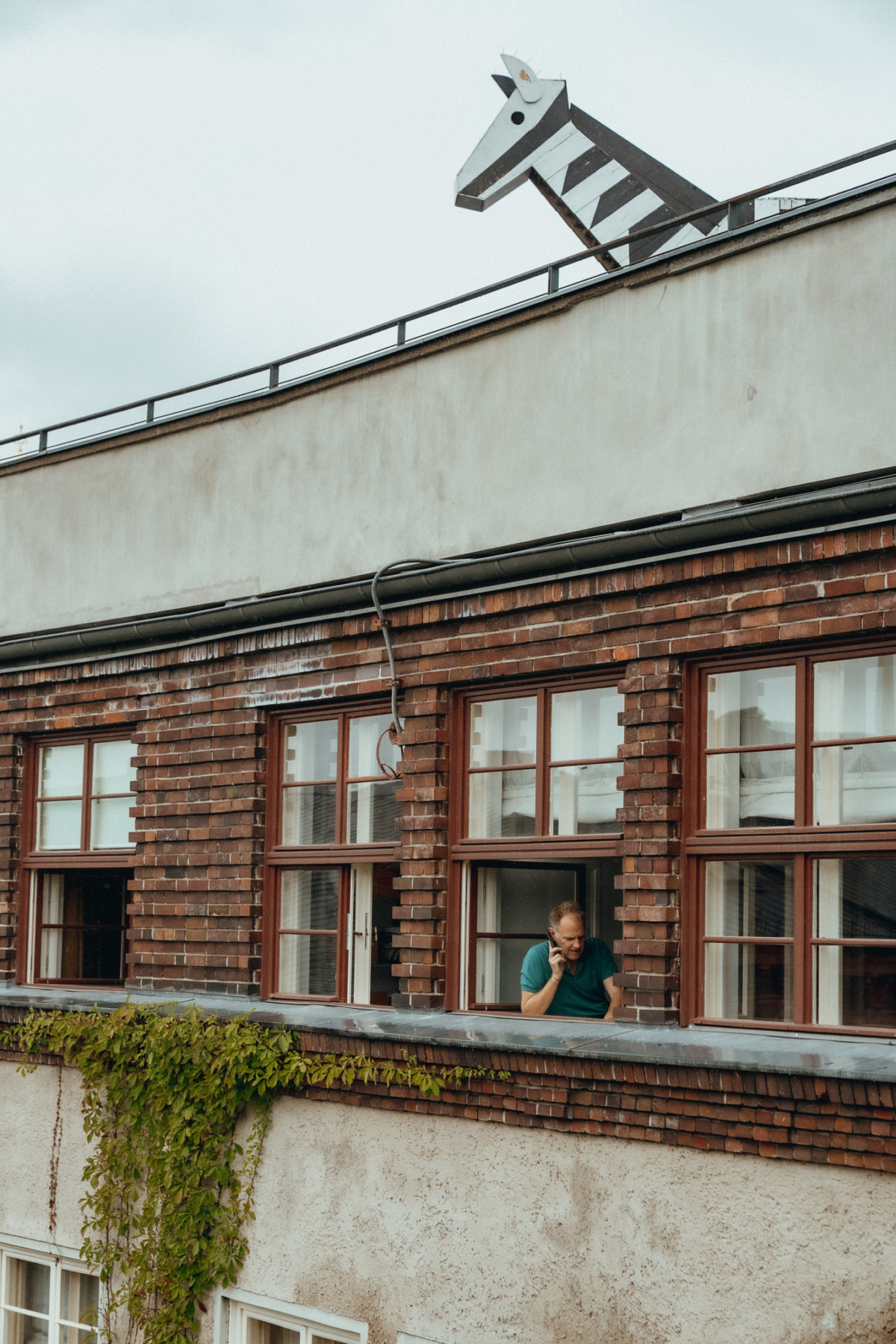
ConstanceThere is the Trojan zebra from Tomi Ungerer. He passed away a couple of years ago, but he was a famous children’s book writer and designed for us one of his book characters. It’s a sort of fort inside a giant zebra. There’s also a sausage swing, which the kids absolutely love, from a Mexican artist called Gabriel Rico, who wanted to have a little humor celebrating Germany with this swing. From Leiko Ikemura, the Berlin-based artist, we have one of her Usagi sculptures: a creature looking like a rabbit, wearing a dress that the children can enter, which is another way for them to hide inside.

-
FvF
You open the playground to the public, and the apartment is designed for hosting events. How do you strike a balance between having a space for entertaining and a private home?
ConstanceWe both sell art for a living: Michael has a gallery and I’m an art advisor. Except for the works that we own, you can’t get attached to the pieces, because they’re for sale — that’s part of the job. Michael likes to say that basically everything is for sale except for his wife and children, and maybe me sometimes [laughs]. But this is also, for us, the best way to show our clients how to live with art and, luckily, it works. The art keeps on changing, and this is also what keeps the house so lively. You don’t get bored, because it’s a constant change.

-
FvF
What spaces in the house do you gravitate toward when it’s just your family?
ConstanceWe love cooking — it’s a big passion and it’s why we chose to have an open kitchen. This is where everyone gravitates at the end of the day, from the guests to the family, and it’s great for it to be part of the living room. I grew up in Paris in a house that was like a London townhouse, where every room is on a separate floor. I saw that this isolates every family member very fast, because everyone ends up staying on their own floor, and I never wanted to have that for my family life. It was important for us to have an open floor plan, with one common living area, and this is what we did.

-
FvF
Do you both also work from home?
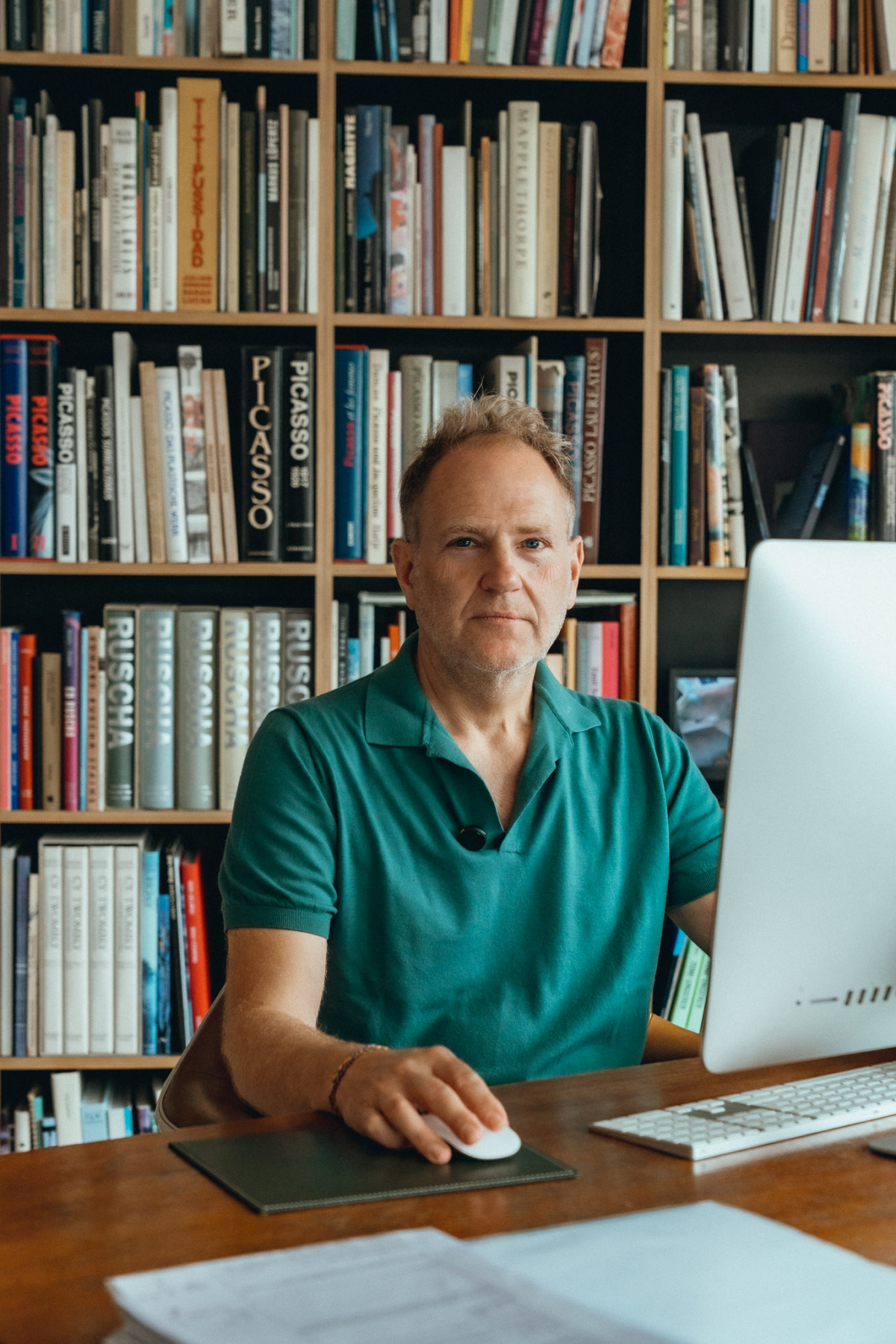
ConstanceWe do. We have a shared office, which I would say is the biggest luxury we can have. We both have very nice [Jean] Prouvé desks. I ended up with the smaller one, and Michael has the big one. Michael’s gallery is downstairs. Most of my projects are in Paris, so this is a way to escape Berlin when I have to implement a project, but otherwise we work from home.


-
FvF
It’s nice that you are able to share your personal and professional lives — a lot of couples could never do that.
ConstanceMore or less, I changed my career when I met Michael. I realized that if you want to live with somebody who is in the art world, the life is so nomadic that you have to do the same in order to be able to follow them. Otherwise, you never see each other. I changed my path completely when I left New York — I was working as a diplomat before. This was the best move. Of course you argue sometimes, but our job is not only a job. It’s a passion, it’s our life, and I don’t think there’s one moment that we don’t have anything to say to each other.


-
FvF
Do you both also split your time between Berlin and Paris?
ConstanceNow, yes, because we just finished our place, which is also a showroom, based on the same concept as in Berlin. We just had our first dinner party.


-
FvF
You’ve said that the way to make it work for the kids is that you basically replicate the entire household. What do you mean by that?
ConstanceWhen they were smaller, I had two of everything, and a nanny traveling with us. For them to be comfortable, you need to have the same setup. The main difference is that in Paris, they share a room, which I actually wanted to do in Berlin — I thought it would be nice for the children to bond, but we had enough space. Otherwise, the setup is quite identical. Fewer toys, but as much art in their rooms as they have in Berlin.

-
FvF
They must be happy with their French-German existence.
ConstanceIt’s not even bicultural; it’s tricultural. They’re in an international school in Berlin, and with our friends in Berlin — you know how it is — we live mostly in an Anglo-Saxon environment. They definitely speak French with an accent. I don’t speak German, but I think that their German is absolutely catastrophic.

-
FvF
You are now at the exact midpoint of your 30-year takeover of the building. Do you have a plan for what will happen in 15 years, when the lease runs out?
ConstanceThe beauty of our lives is that there’s always a new project coming up, so you never know. Maybe we can continue the lease, maybe not. The story remains open.