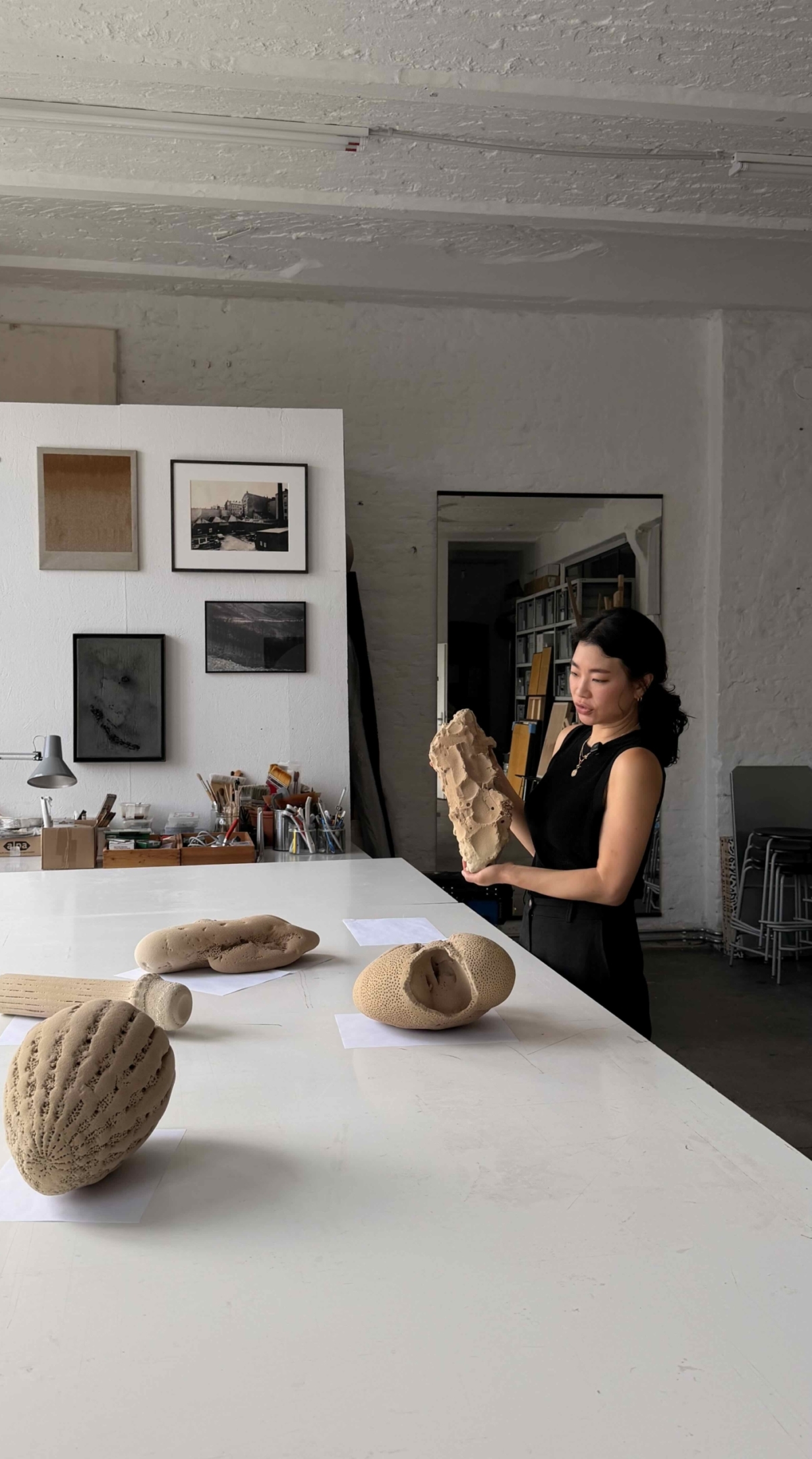
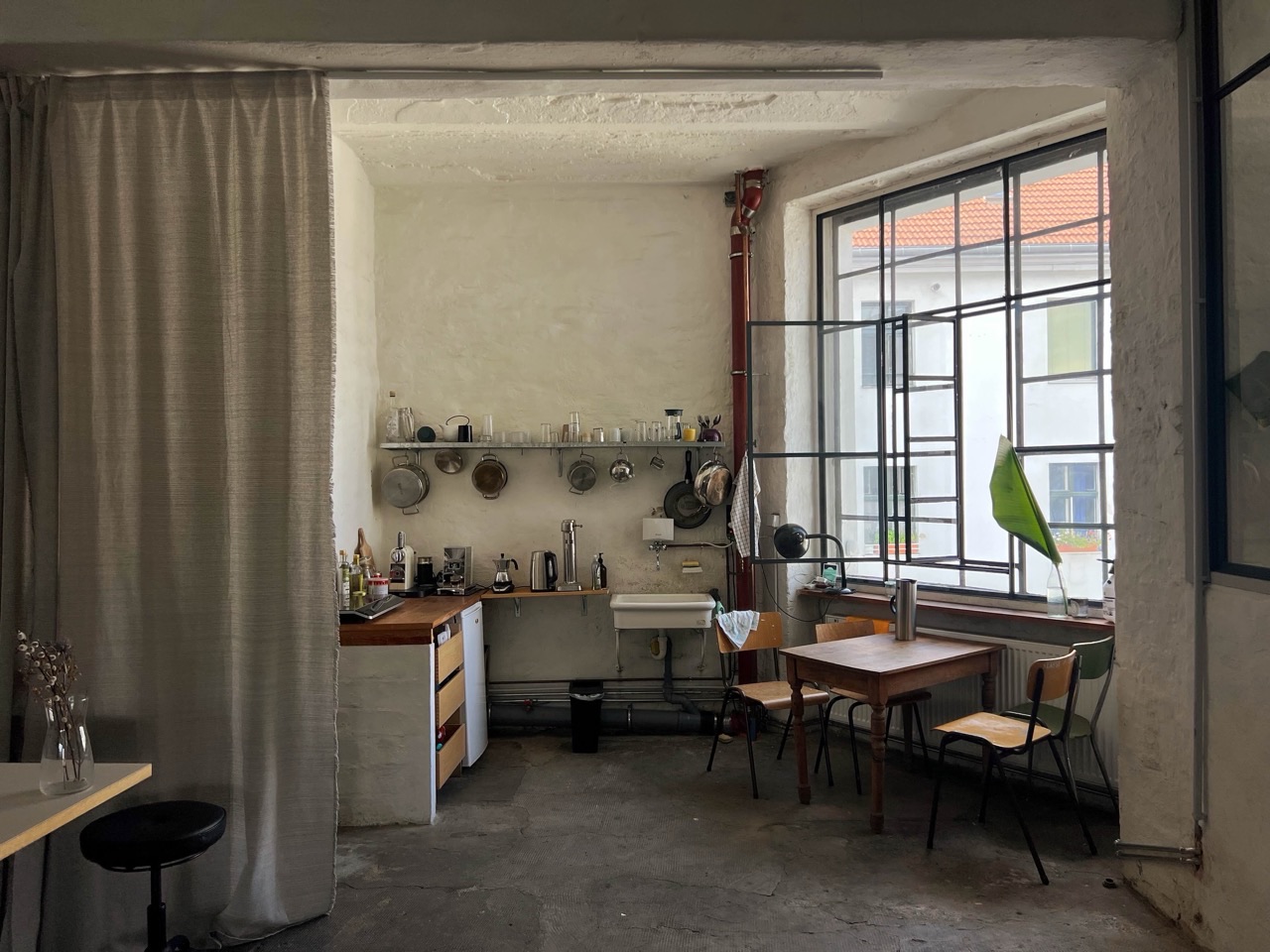
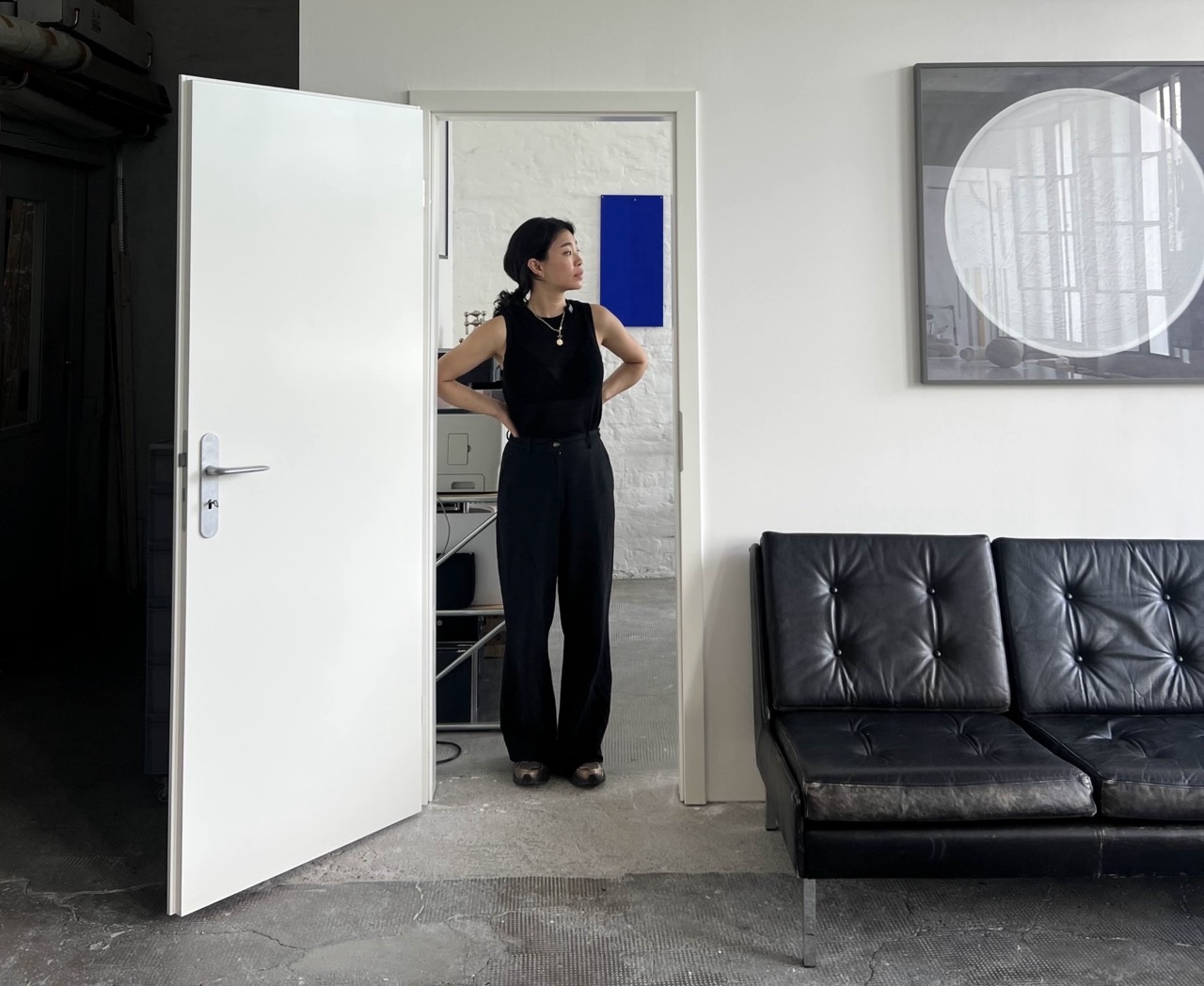
We meet artist Jeewi Lee in her studio in a Kreuzberg Hinterhof. Beautiful, multicolored stained-glass windows guide the way up the staircase. The building belongs to a glassmaking company, with studios tucked away at the back. Here, Lee, who also lives in the same building with her husband and child, shares a lofty studio space with other creatives.
Jeewi Lee’s relationship to Berlin began long before she made the city her own. Her parents, both artists — her father a sculptor, her mother a painter — moved to Berlin from Korea to pursue their studies at the Universität der Künste when Lee was five years old. Years later, after the family had returned to Korea, Lee came back to Berlin to follow in their footsteps. Moving between cities, countries and cultures, ideas of belonging, the question of what constitutes home became a fundamental undercurrent in her work.
Lee’s practice is driven by an intense curiosity. She researches, investigates, and turns questions over like rocks, looking for what might lie beneath — only to find more questions. Contradictions fascinate her: the obvious and the hidden, presence and absence, permanence and movement. Her work moves between conceptual rigor and material research, returning again and again to contemplations on memory, time, and the traces left behind by people, objects, and events.

-
FvF
You have an upcoming solo exhibition at Berlinische Galerie as part of the GASAG Art Prize, which you were awarded. What is the main focus of this current body of work?
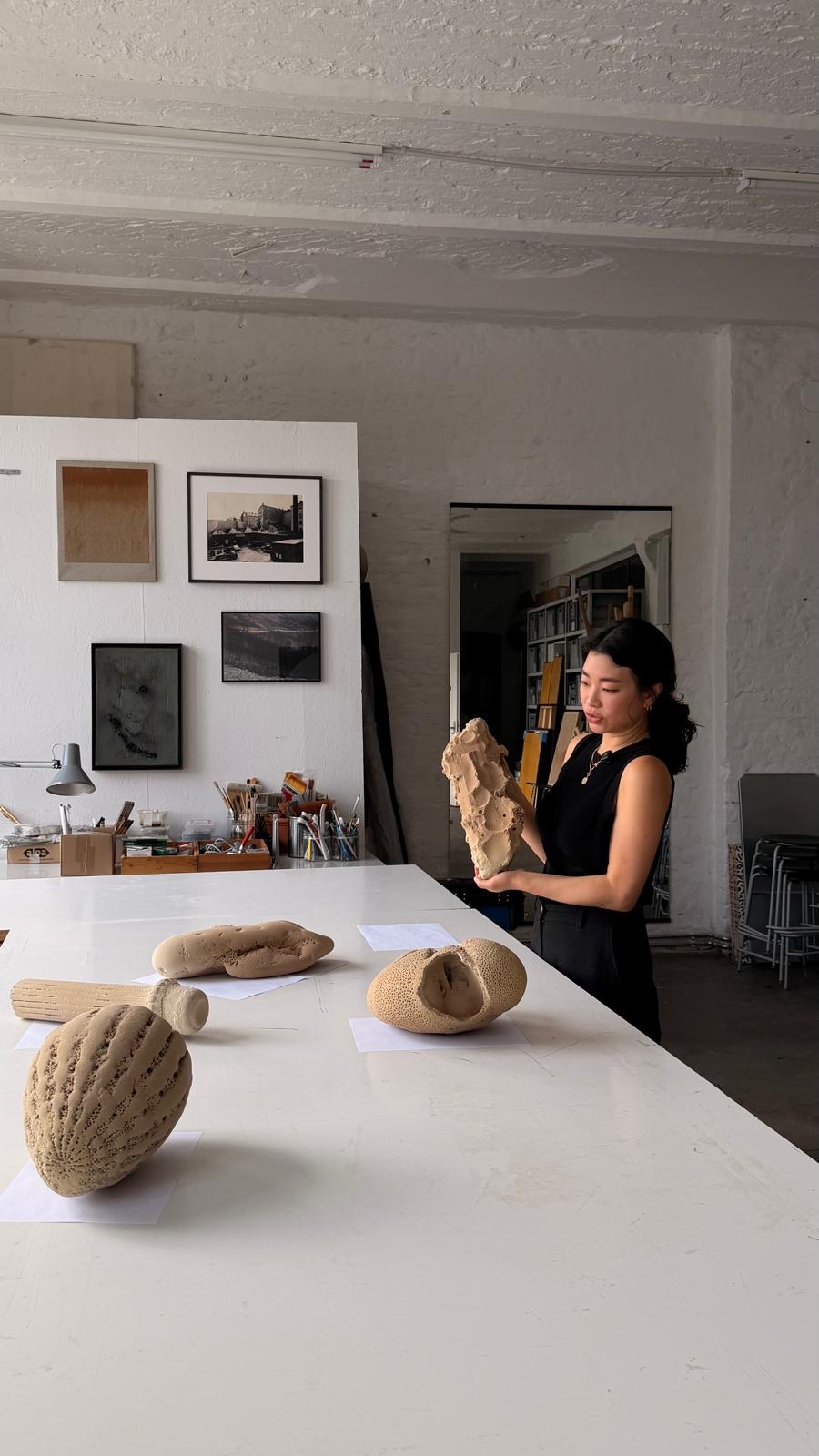
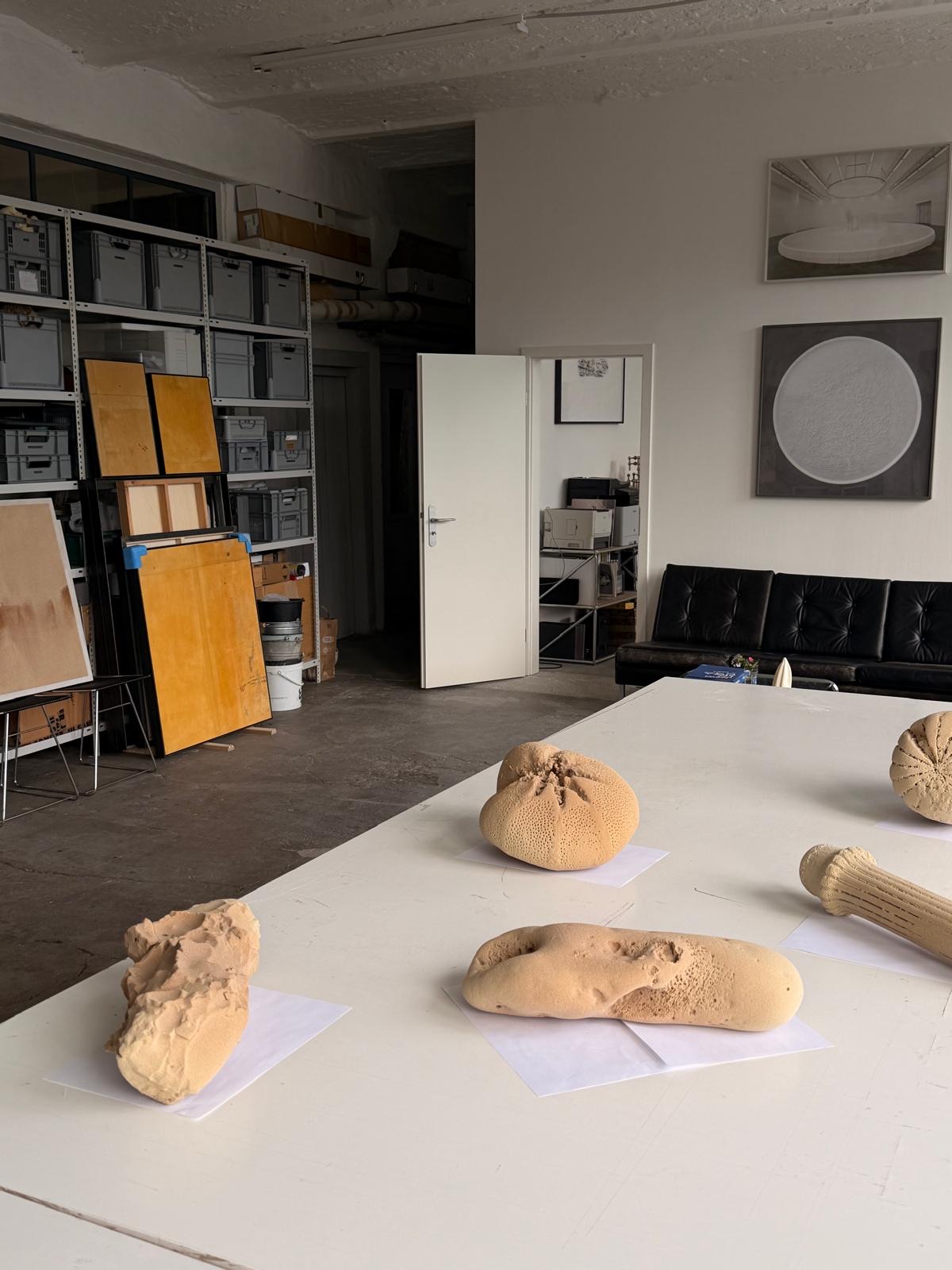
JeewiAll my work is about traces. In traces, presence and absence coexist equally; it is where the past and the present meet. A trace in itself also contains a lot of time and events. In my earlier work, I dealt with these almost forensic types of traces. Over time, I went more and more into the abstract. In this next exhibition, the main protagonist is sand, which will be shown in a large spatial installation, as well as in sand sculptures and sand paintings. Every painting is made with sand from another coast or beach.

-
FvF
According to which criteria do you select the places of origin?
JeewiI have a collection of sand from the different places where I have worked and lived. I always take sand with me, which is actually officially illegal. I find it so absurd because sand itself is always traveling and rolling and flowing.
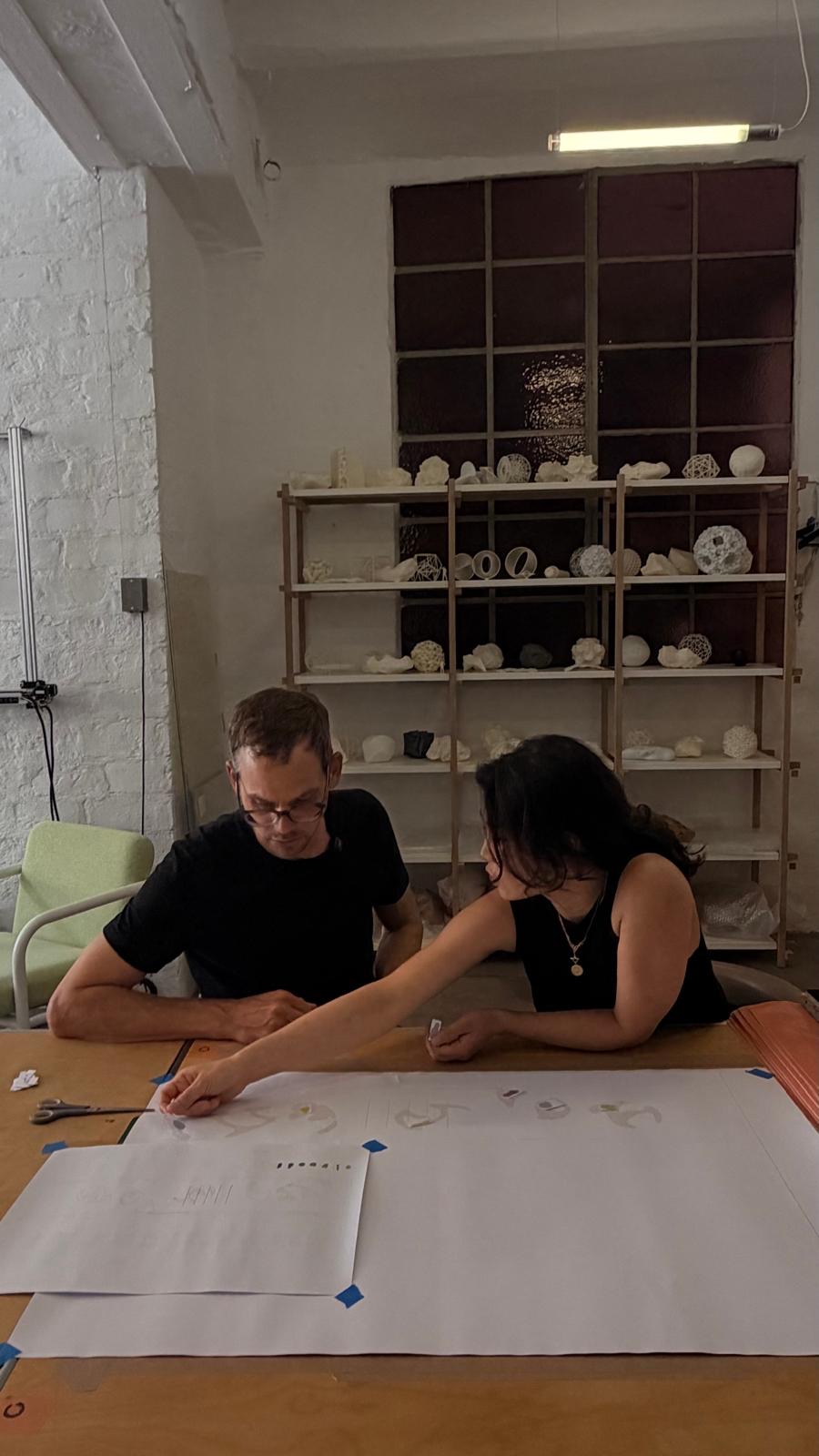
I work very closely with a geometric researcher, Philipp Reiner. We both look at the sand under the microscope. Over several days, very meticulously and selectively, we choose the right one from the different places. Sand grains all look different, but there is always a signature, a character for the place where they come from. Under the microscope, I realized that there are much more organic forms: stone, coral particles, shell particles, and so on. Some of the most exciting forms come from Mallorca, for example. Once we have chosen a sand grain, we use very high-end measuring technology to scan it, which can take up to nine hours. Afterwards, the scan is used to print a large version of the grain in 3D sand.

-
FvF
In enlarging the sand, it shifts from universal to highly precise. What happens in the deconstruction of the object for you?
JeewiWhat I find exciting is that you change the perception and that you suddenly have sand grains enlarged several thousand times in the sculptural space. You can experience them physically and spatially. Metaphorically, this means to say: Hey, let’s give every sand grain the full attention they actually deserve. Because in every sand grain there is so much history. Sand, to me, is a nomadic material that has been traveling for millions of years. It could sit firmly on a coast for a hundred years and then suddenly be picked up by a wave the next morning and be on another continent in a month.
This is potent especially nowadays, when all these oceans are so incredibly political. They used to be shared pools. But now there are all these limitations: who is allowed to pass through and who is not. And the sand grain itself is constantly at the border.
We have trained ourselves to think that ground must be firm. It’s about territory and who is allowed to stand where. But sand is like liquid earth.


-
FvF
A democratic medium.
JeewiExactly. It is constantly flowing and flying.
-
FvF
Time, the past, and the present are key topics for you. A thought Heidegger has explored is that the past is never closed, but always carried into the present. This kind of fluidity finds its way into your work too.
JeewiFor me, it is also Asian philosophy that has influenced a lot of my work, just as a cultural byproduct. In Asia, basic philosophies and everyday philosophies are very influenced by Taoism. There is a lot about this principle that emptiness and fullness, and being and not being, are always equated. This is very different from the Western worldview, or especially from the way art is viewed in the West. There is always a hierarchy in how you analyze pictures, whereas in Asia you always think in relation.
-
FvF
Do you mean simultaneity?
JeewiYes, and also equality. Presence and absence exist at the same time, with the same weight. Something might not be there anymore, but there are enough indexicalities that make its absence present in a different form. It still speaks of the event.
-
FvF
You had a show in Arnsberg many years ago, Der Abgang (translated: The Departure), about the presence of an elephant in its absence. While the elephant wasn’t in the space, his dung had left a clear note of his existence.
JeewiThe dung was not there either, but the room had a very, very strong smell. It was based on a previous show from 2016, Blinder Beifall (translated: Blind Applause). I invited a whole circus into the gallery space, but when the audience came, they had already left.


-
FvF
You photographed the arena from above, and all we see is a circle of traces in the ground.
JeewiWhile the artists had already left, there were enough clues to be able to imitate the circus. Signs of different animals walking in a circle, a wheel, footprints of the clown because he was wearing oversized shoes. But the elephant didn’t fit in there.
The curator of the Kunstverein in Arnsberg called me afterwards and said, “I thought your project was so wonderful, but it was so funny that the elephant didn’t fit into the space. Let’s do a project where we invite the elephant.” But then it took a completely different direction, as the veterinary office told me that I could only transport animals for reasonable reasons. Which leads to the question: what are reasonable reasons? If a pig is taken to the slaughterhouse, is that reasonable? Does a dog need permission to go on vacation?
Long story short, the curator and I spent half a year just sending official letters back and forth, and then we said, if I can’t physically get the elephant there, how can I bring it to Arnsberg? I thought about it for a long time and came to the conclusion: an elephant is the hay. An elephant eats about 200 to 300 kilos of hay a day. And they poop 100 to 150 kilos.
So I spent a few days at the elephant farm and took exactly the daily quantities, 300 kilos of hay and 150 kilos of poop, to Arnsberg and put them in this glass-box exhibition format. The body of the elephant is imaginary, of course. But it is in the room in its digested form, as the hay has traveled through its body. I left the dung in the space during the installation and took it out before the exhibition. All that remained was the smell.

-
FvF
The topic of presence and absence is still an important part of your work today.
JeewiA lot of people think that working with traces means working with something in the past. Which is a misconception, as the past is already in the future. It’s more of a cycle than something linear. In 2019, I made a project called Ashes to Ashes. In September 2018, a forest fire raged on Monte Serra, devastating 600 to 700 hectares of mountain woodland. I produced soap sculptures made with natural oils as well as particles from the Tuscan forest’s scorched trees.
The project was not just about climate policy or pointing fingers at someone as the villain. But what actually moved me is that nature is actually so much more powerful. After an ancient forest burns down, which is of course tragic, the earth becomes incredibly fertile. You think, wow, the whole forest died and this is the end. But actually, this ash is one of the best fertilizers to grow new life.
This is the cycle I am talking about. The new is already programmed in the past.


-
FvF
It seems that you like contradictions. They recur all over your work.
JeewiObjects inspire me first when they have contradictory components. Sand grains, for example, are often used as a metaphor for infinity, in literature and in films.
But sand is actually finite, as it is being used up at an incredible rate. This is a very acute topic in politics, economics, and ecology for which we humans have to find a solution.
In our everyday life, sand seems like a worthless, banal material. But it is highly valuable. There are conflicts between countries and corporations over sand. And that is also a controversy or a contradiction in a material.
And then, in our projects with sand, we use the best high-tech to make these sculptures. Another contrast that I find very exciting.
-
FvF
High and low material at the same time.
JeewiExactly.
-
FvF
In Fields of Fragments, you work with old Korean floorboards, made out of paper, that carry the past in their form.
JeewiI thought in the literal sense that Korean everyday life is drawn on the floor. They use oiled paper as floorboards. It is a simple floor, but you can read out a lot of culture and information. In Korea, it is very common to have floor heating. When oiled paper is heated again and again, it yellows. And Korea has a seating culture; a lot is done on the floor, so you automatically leave more traces. The floor embodies all this information and carries it within itself. To me, this indicates something very intimate.

-
FvF
You told me recently that you moved back and forth in your life so much that no feeling of home has set in for so long. I asked myself whether all the work with past and present, absence and presence has, over time, reconstructed something in you that feels like a self-made pattern of home.
JeewiYes, I think so. And maybe my art, in a way, became the answer to this eternal search and question, which is also the red thread running through my work and all my interests. And in that, I somehow created a home for myself.

-
FvF
Did the absence of a feeling of home burden you before?
JeewiYes, a lot. The question of belonging was a real complex for me for a long time. But now Berlin is the place in my life that I have lived in the longest.
-
FvF
Does it feel like home here?
JeewiYes, it does. But as you said, I found home in my art and can establish a sense of belonging much faster, also somewhere else. When I had a residency in Senegal, Senegal immediately felt like home, as if I had been there in my previous life already. I think it is also about staying open to unconscious connections that create a sense of home, when one project leads to the next. I realized that there is not only one definition of home, or that it’s not necessarily connected to a place.


-
FvF
What would you say is the feeling of success for you, or what does success mean for you as an artist?
JeewiMy mission with my art is not to teach. What makes me really happy is when people experience very subtle shifts in their perception in their daily lives. It moves me when you can sharpen perception with subtle gestures.
-
FvF
Both of your parents are artists. Were they supportive when you decided to also choose this path for yourself?
JeewiI think in the beginning they were more against it, especially my father. He knew how hard it can be to be an artist. I understand him.
As a teenager, I more or less secretly applied for a kind of art high school. I was so disciplined. I was painting until 4 o’clock in the morning while my parents were sleeping. I was then accepted to this art high school. Since then, they have supported me and still do.


-
FvF
You have an impressive record of grants, residencies, and prizes. As a conceptual artist, which is not always the most commercial path, these opportunities can be particularly important. What do you think makes you a good candidate for these highly sought-after programs, such as Villa Romana, the Goethe-Institut, or Villa Aurora in Los Angeles?
JeewiI think I am like a sponge; you can feed me a lot of information. And when you show me new materials and the story, or when I talk to a craftsman for a longer time in a village, I get a lot of inspiration. I digest it and cook something out of it. I can really use a residency well. I work with the place specifically and transform it into something that then grows from there. A lot starts to unfold during these travels, where doors just keep on opening up. This shapes my work a lot. Of course, in my everyday life in Berlin, things can also happen, but you are open or open-minded when you are somewhere else, in a foreign place.
-
FvF
And if you would give younger artists some advice, what would you say?
JeewiFor example, how important it is to document your work, to photograph it, to make really good photos. To always be ready to show your work: a website, a portfolio, photos.
I think you need really thick skin in this profession. In the end, you never fully achieve something. And that’s also what an artist’s existence lives from. There are more questions, more experiments; we keep searching. There is no goal where we have fulfilled everything and found all the answers. There are so many hurdles and moments that feel like failure, and you need a kind of endurance where you think: I’ll keep going.



-
FvF
Where did you get that from?
JeewiI think I owe a lot to my parents because they gave me a belief. I think that’s really something I’m very grateful for, that they gave me a kind of self-confidence. We discuss art a lot among ourselves. My younger brother, who lives in Berlin, is also an artist and is very supportive. We all help each other a lot.
-
FvF
Community is important.
JeewiYes, totally. Being an artist is a bit of a lonely job — that’s why solidarity, standing together, and supporting each other, and community, are very important.