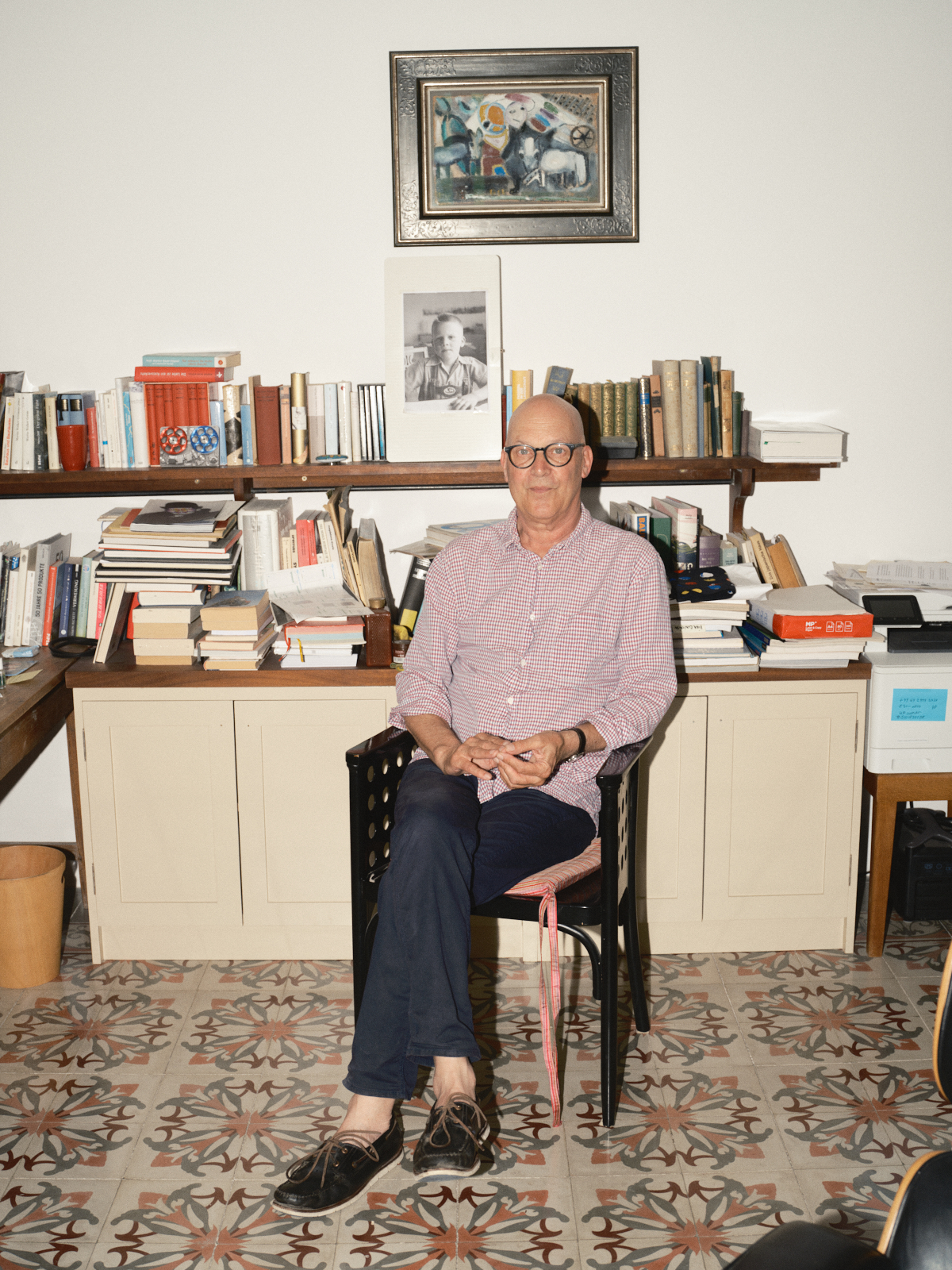
Matthias Dietz has lived many lives, at least seven, he tells us. In the 1970s, he traveled to New Mexico as an eco-activist and learned to build geodesic domes and wind turbines. He has made design books for Benedikt Taschen, worked for Marlboro and designed the branding for Daimler. “At some point I had achieved everything I wanted to achieve,” he says of himself, and sold his agency. Then he bought a hundred-year-old shoe factory with a tower in the Tramuntana Mountains of Mallorca, empty for 40 years. Almost a ruin, but for Matthias, a dream house. With painstaking attention to detail, he brought the building back to life, following what he describes as the wabi-sabi principle. Matthias is considered one of Germany’s leading experts on wabi-sabi.
Locally, his house is known as “Can Vellut,” the house of the Vellut family, who owned it for nearly a hundred years before selling it to him. At his retreat, he receives guests from around the world. “A retreat is a place where people can meet one another, but at the same time a place to withdraw into stillness,” he says. “I spent time once in a Zen monastery in Japan, and I think we need periods of quiet now and then before stepping back into communication.”
-
FvF
How did you find this house? I’ve heard there’s a particular story behind it.
MatthiasI saw the house while hiking through the Serra de Tramuntana, and I thought immediately: This looks like the house of my dreams. Big windows, high ceilings, a tower with a view of the highest peaks. And that despite the fact that it was really a fairly derelict old box, covered in black mold on the outside, with cracks in the walls, and empty for 40 years.
Two months later, I did some research into whether there were interesting houses in the area, because a colleague of mine, the typographer Peter Zizka, lived here in the Mallorcan mountains.
I’ve known Spain for a long time. From the late 1970s into the early ’80s, during the post-Franco period, I traveled through Spain in a truck. I also spent a lot of time in Mexico, and since then I’ve spoken a kind of street Spanish I picked up along the way. I was married for 20 years to a Catalan woman in Berlin, and we have two children who also speak Catalan and Spanish. So Spanish culture, or specifically Catalan culture, which is similar to Mallorcan culture, feels familiar to me.
And the moment I saw the house on Idealista, a real estate website, I thought: I know this house. This is the house of my dreams. So I flew here the very next morning. I was the first person to get the key. What I didn’t know was that the house had been in the same family for a hundred years, and that the very day I found it online was the first time in a century that it had gone up for sale.


-
FvF
There’s a sense here that you believe in something like the power of the universe?
MatthiasAbsolutely. I rely on that in my own life, too. I’ve been through many transformations, and you just have to pay attention to what falls at your feet. That’s how it was here. That same day, I met the town architect of Mancor de la Vall and asked whether the house was under historic protection. The next day, I had a woodworm specialist over, drilling and inspecting everywhere. All the furniture in the building was infested with woodworm. Nothing in the house had ever been changed. Everything was original from 1926, a hundred years old, completely furnished with art, machines and the production materials of the old shoe factory. After meeting those two people, I bought the house on a handshake, from an elderly aristocrat, on the third day. The real estate agent said she’d never seen anything like it in her life.
-
FvF
How did the renovation go, then? How did you approach it?
MatthiasI’m an industrial designer. My grandfather helped finance the Bauhaus and was involved conceptually and in distribution; he put the Wagenfeld lamp into series production, for instance. There’s a kind of “hereditary burden” of design in my family. Our father was chief financial officer at Olivetti by the time he was 23; our mother met him when she sold him an avant-garde Italian desk. We grew up with a Braun stereo system and Knoll International furniture. Design has always played a major role. In the mid-1980s, when I was 27, I managed the construction of one of Germany’s largest building sites, for one of the first postmodern bank buildings in the country.
So I can handle architecture, but I never wanted to own a house. My parents spent more than ten years building a villa in Frankfurt with a star architect. The project went through what felt like 50 marital crises and generated no end of family conflict. So I really never wanted to build or own a house of my own. My parents’ house turned out, in the end, to be a truly wonderful house, both ambitious and modest at once. But I only lived in it for six months before I disappeared to Berlin, into the walled city. That was my trauma, in a sense, but on the other hand, I’d absorbed a great deal of knowledge along the way.
My plan for the house in Spain was simple: I’ll put in a few wood stoves and otherwise leave everything as it is. As I was signing the purchase contract, pen already in the air, the seller mentioned, almost in passing: “Oh, by the way, the electricity in the house runs on the 110-volt standard, as was common in 1926.” I couldn’t even buy light bulbs for that anymore; they didn’t exist. But it didn’t matter anymore. I signed the contract anyways.

-
FvF
If I can jump in for a moment, can you point to a particular turning point, a moment when something clicked, moving you from that trauma you mentioned, not wanting to own a house at all, to the longing for a place that would be yours?
MatthiasYes, that was in 2022. I remember thinking: Where is all this bad mood coming from? Post-Covid Berlin felt different. Something had changed for the worse. Berlin no longer appealed to me the way it had for the 50 years before.
So I set off with little luggage and looked at a few places in Italy and Spain. A friend I also work with professionally, the typographer Peter Zizka, was already living in the Tramuntana Mountains of Mallorca, and that gave me a foothold there.

-
FvF
Anyone who has lived in a big city for a long time knows how valuable it is to have a friend nearby.
MatthiasExactly. In any case, there was still some unclear motive pushing me to transform myself, something to do with finding a bearable pace of life, and something to do with economic sustainability. Whether that would be possible in Berlin was very uncertain. So the vague idea was to run a house in the mountains in Spain, where interesting people could meet one another. Somehow it all fit. I already knew Spanish culture, I understand the language, and I have some sense of how Catalans, or Mallorcans, think, and I had a friend nearby.


-
FvF
You’d observed the existential worries, the post-Covid discontent, in the people around you in Berlin. You changed your life by moving to Mallorca. When you change something fundamentally, it usually hurts at first. How do you know it’s the right thing?
MatthiasYou don’t know, really, and that’s a good thing. Anyone who brings time with them has the chance to open up. Recently, a well-known architect stayed here; he runs a large firm and builds high-rises. He was here for two weeks, and we cooked together every day. Within that setup, we invited interesting people who came from Berlin.


-
FvF
You bought the house in December of ’22, arriving with just a weekend bag and an old camp bed of your grandfather’s. You spent a year without any comfort, no?
MatthiasThere was no heating, just a hot shower the plumber had quickly installed, and 110 volts, which was just enough to charge my phone. Otherwise there was nothing. A beautiful, cold, empty house with 15 rooms.
I didn’t start right away with a plan and a renovation. Instead, I deliberately did nothing for a year. I built relationships in the village, slept in every room at some point, and watched how the house changed through the seasons.
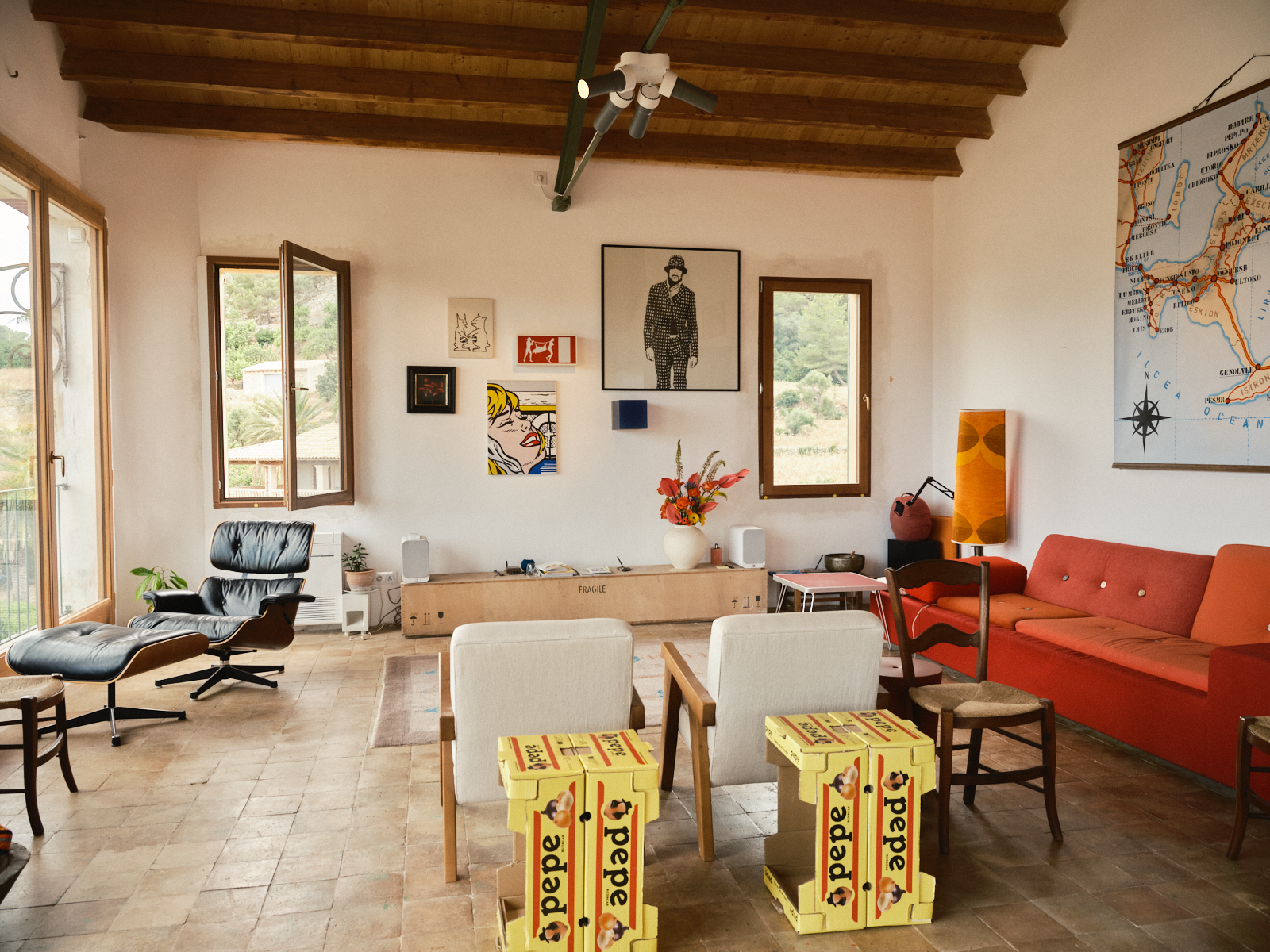
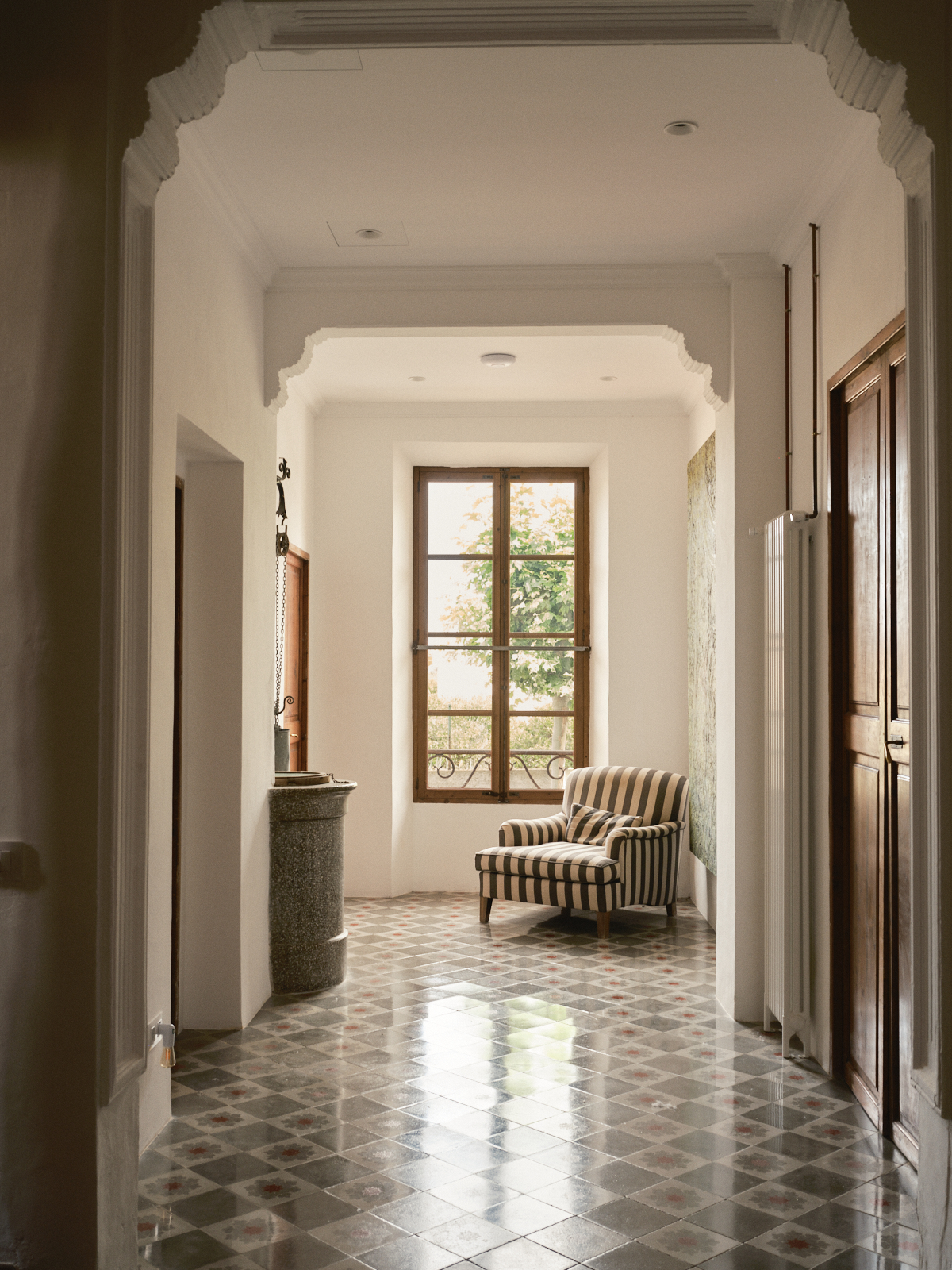
It’s an Art Nouveau house, or a modernist building, one of the few modernist houses standing out in the countryside. That made it harder to renovate. The varied, playful, colorful tile patterns define the floor plans, so it was almost impossible to install underfloor heating or move walls. No way. Every room has a different mosaic floor. That’s a defining element of this architecture.
During that year, before any construction began, my ideas slowly took shape: What would I actually want to change, and how? And because I thought it through so thoroughly instead of jumping straight in, installing aluminum double-glazed windows, say, since my resources are limited, too, I spent a year and two months renovating with local craftsmen. Playing every role along the way: I was the designer, the client, the financial controller, the investor, the site manager, whatever was needed.


-
FvF
You published the book “Wabi-Sabi.” Is this a wabi-sabi house, too?
MatthiasYes, in a way it really has become a wabi-sabi house. The principle of wabi-sabi comes from the Japanese tea ceremony and is several centuries old. It stands for modesty, without glamour or excess: simplicity, reduction to the essentials, leaving out everything superfluous. Even though it’s about much more than that — stillness and slowing down, calm, seclusion and unobtrusiveness — the principle translates very well to design. It’s about the idea that nothing stays the way it is. Nothing is ever quite finished, nothing is perfect. Something is beautiful when it is imperfect. Beauty is patina, wear, aging and decay.
And of course, I saved the house from decay — which is actually a contradiction of wabi-sabi. [Laughs.] In any case, my closeness to these principles is part of what made it such a special house.
Precisely because of my background in design, the execution wasn’t easy. I know what it’s about and how I want it. But then try telling a Spanish craftsman, “I want the wall to look as if it were old. I don’t want a straight wall, I don’t want perfection, I want to see traces of the work, and I want to use old wood, not new.” That took some convincing at first.
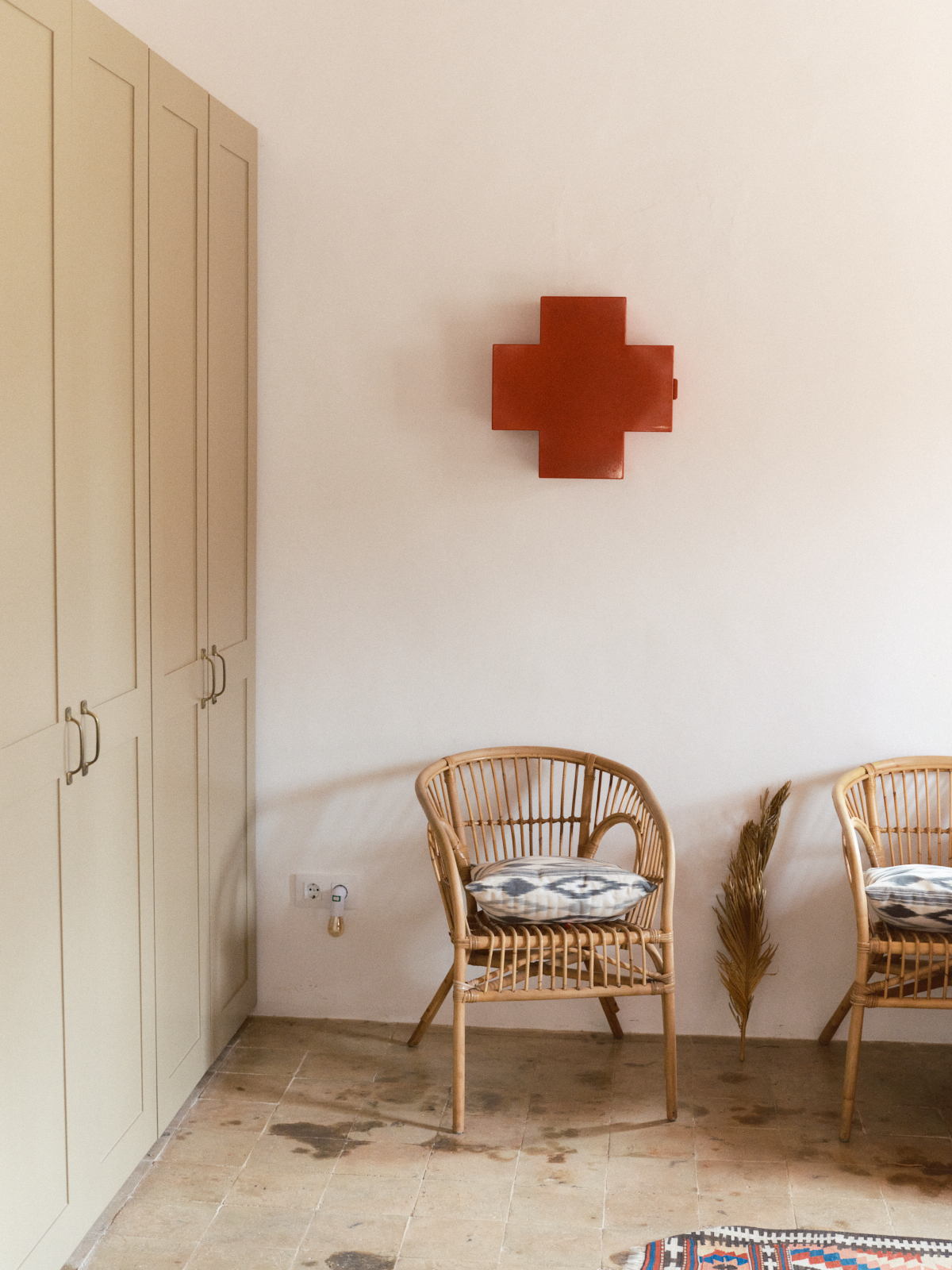
I also bought old furniture. At home, I live with 1960s Italian minimalism, but that doesn’t really belong in this context. The design pieces now stay in the background, because the house is furnished with things that look as if they’ve always been there.
It was important that the old wallpaper stayed. I didn’t want to change the floors or the floor plans. And then the question: How do I hide all the climate-neutral high tech — Wi-Fi antennas, water supply and drainage pipes, concealed electrical conduits, heat pumps, water treatment — without the house losing its character? We pulled it off. And that was only possible by refusing to compromise.


-
FvF
On that note, you knew what the house looked like, since you saw the old furniture. Could you use that as a kind of template, aesthetically?
MatthiasNo, it wasn’t like that. The house was really more of a hundred-year-old junk room. But the good part was that nobody had ruined it through interventions or changes, say, in the 1960s.
I took over an empty house, and during the construction phase I’d buy and store things here and there, and in the end put everything in place, without knowing exactly what would go where or how it would all look in the end. After that, over the course of a year, I kept moving furniture from one room to another.
And at the end came the hanging of the pictures. A small art collection that used to hang, rather densely packed, in my place in Berlin’s Hasenheide neighborhood. Now everything has its own space, and it breathes.


-
FvF
What kind of art collection is it, and what are the pieces of furniture you’ve gathered over time?
MatthiasThe art collection is biographical. There’s no conceptual thread, no collecting idea behind it. It’s more like a poetry album. Every piece marks a point in time in my life, because at certain moments I bought this painting or that sculpture, and in doing so marked the feeling of that moment. Later, you remember, and you think: I know how I felt back then, or what was going on in my life. So a bit like a diary.
-
FvF
Happiness doesn’t necessarily have to be tied to having a lot, objectively, or having a lot of money. There are others who have far more of everything. Why must we imagine Matthias Dietz a happy man?
MatthiasI really am a happy person. That’s true, that’s accurate. If you dig around online, there’s a podcast with a therapist from Potsdam, a conversation with me about happiness. It was a small, intimate space, the fireplace was going, and I told her about my life while this house was being renovated and I was completely isolated. And then, suddenly, it was published, and I have no idea how many people listen to it. There was so much potential tension between those two states. But it’s true, all the same: I am a happy person. I can recognize things that fall at my feet and make something of them. I’m also a connector. I’m good at bringing people together, and I can read people well. I don’t drive up to a house thinking there has to be a parking spot free right out front. If I know where I’m headed and there’s a spot open 200 meters before, I park there and think: That’s good enough.
-
FvF
Was there someone in your family, a grandmother, your mother, a cousin, an aunt, anyone, who you feel shaped you, who impressed you on a human level, someone you thought, I want to be like that too?
MatthiasNo, it wasn’t like that, it was different. I had parents who encouraged me, but also demanded a lot: a musical upbringing, art and music, a lot of travel. An elite humanistic high school. Then a school following the reform educator Hermann Lietz. On one hand. On the other: achievement was simply expected, and there was little praise. That was pretty alienating. It wasn’t so much a voluntary identification as a family demand for success. At first, that led me to move into a run-down, half-derelict building in Berlin-Moabit, Stromstrasse 26, 100 square meters for 100 marks, stove heating, showers at the public bathhouse.


-
FvF
None of us want to hear that, we who have to pay far too much rent under today’s new leases. (Laughs.)
MatthiasRight, but I’m telling you that because you asked whether there was an identification. Of course, I absorbed all of it, but it was more that I was being programmed into a kind of success machine, and I had to push back against that. I had to find my own freedom and do something completely different, like driving through Spain by truck for a long stretch.
And modesty is also a reaction to the grandiosity I have in me, too. Who shows up and buys a 600-square-meter wreck of a place and thinks, I want to live in this? That only works with a dose of megalomania, and at the same time, a dose of modesty. For a year, I walked through the village in my old mason’s jacket. Someone who greets everyone, who wants to belong to that small-town society. Someone who isn’t always driving off, or just here on vacation, but who’s simply present, all the time.
But it doesn’t work without a bit of grandiosity, either, or I never would have taken on this project in the first place. There have been a few more points in my life where I did things without knowing what would come of them, or whether it would go well. But it’s really quite simple: To decide is to give something up. And I can do both. (Laughs.)
-
FvF
The grandiosity also brings the courage to take on certain things?
MatthiasExactly, they’re basically synonymous.
-
FvF
Matthias, I didn’t do any interviews for quite some years now. But this used to be one of my favorite questions: What would you say to your 16-year old self?
MatthiasThat everyone else is figuring it out as they go, too, and that it’s all right to take a chance and stay true to yourself. That you don’t need to make things more complicated than they are. Take your time, go step by step, and don’t let yourself get pushed into a pace that isn’t your own.

-
FvF
Would 16-year-old Matthias have been happy to know that this is his life now?
MatthiasYes, I’ve actually asked myself that question before, so I can answer it quickly. What would today’s Matthias want to say to the Matthias of back then? I was often too fast, too superficial, and if I’d taken more time and done things more thoroughly, my potential might have unfolded differently. So I rushed through the first 30 years of my career, and only recognized late where my real strength lay.
-
FvF
But maybe then you wouldn’t have had the resolve to turn that key the moment you found the house?
MatthiasSure, which is exactly why the question is hypothetical, and has nothing to do with reality. It’s just a reflection on what that 16-year-old didn’t know. But it’s a lovely question. I like it a lot.