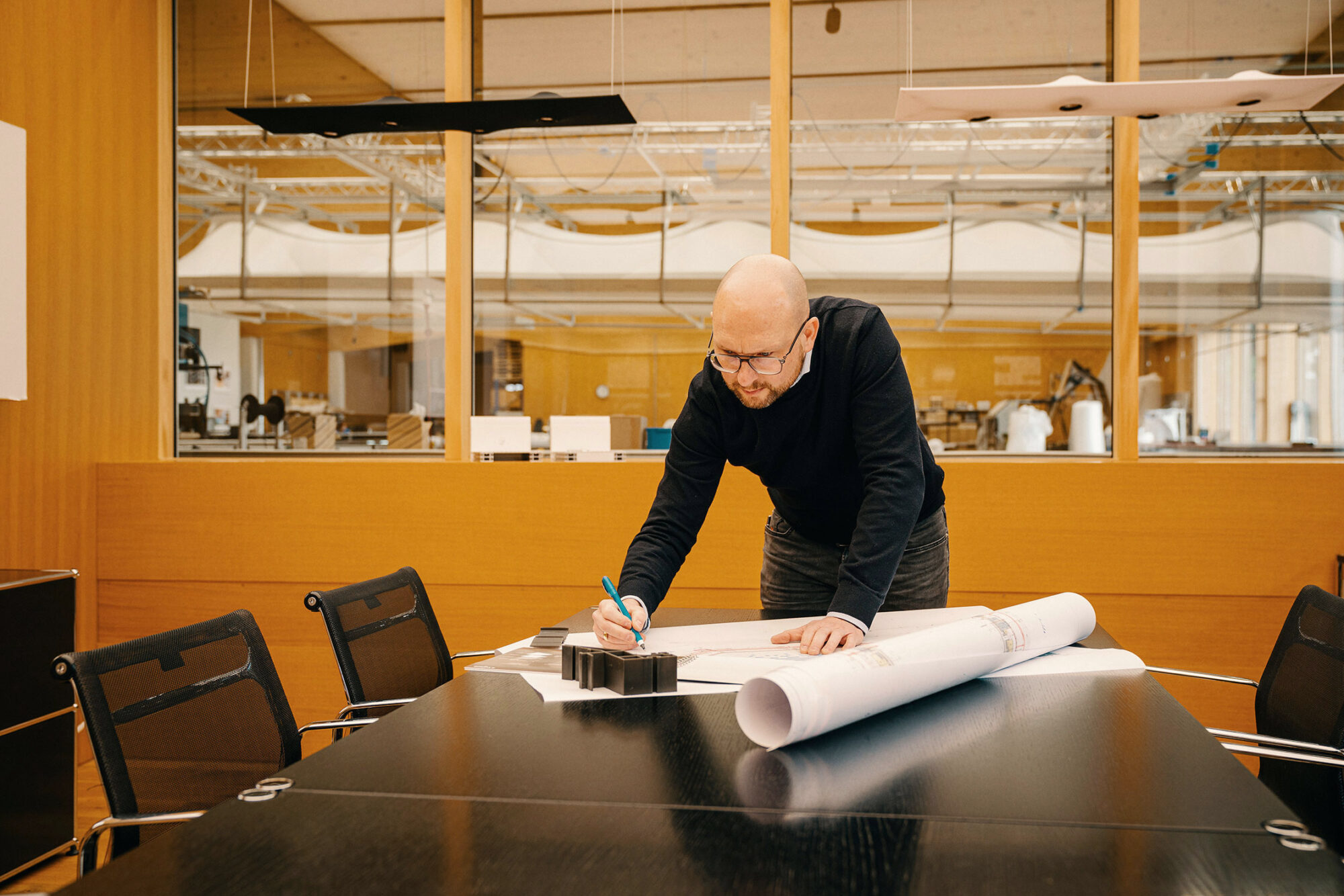
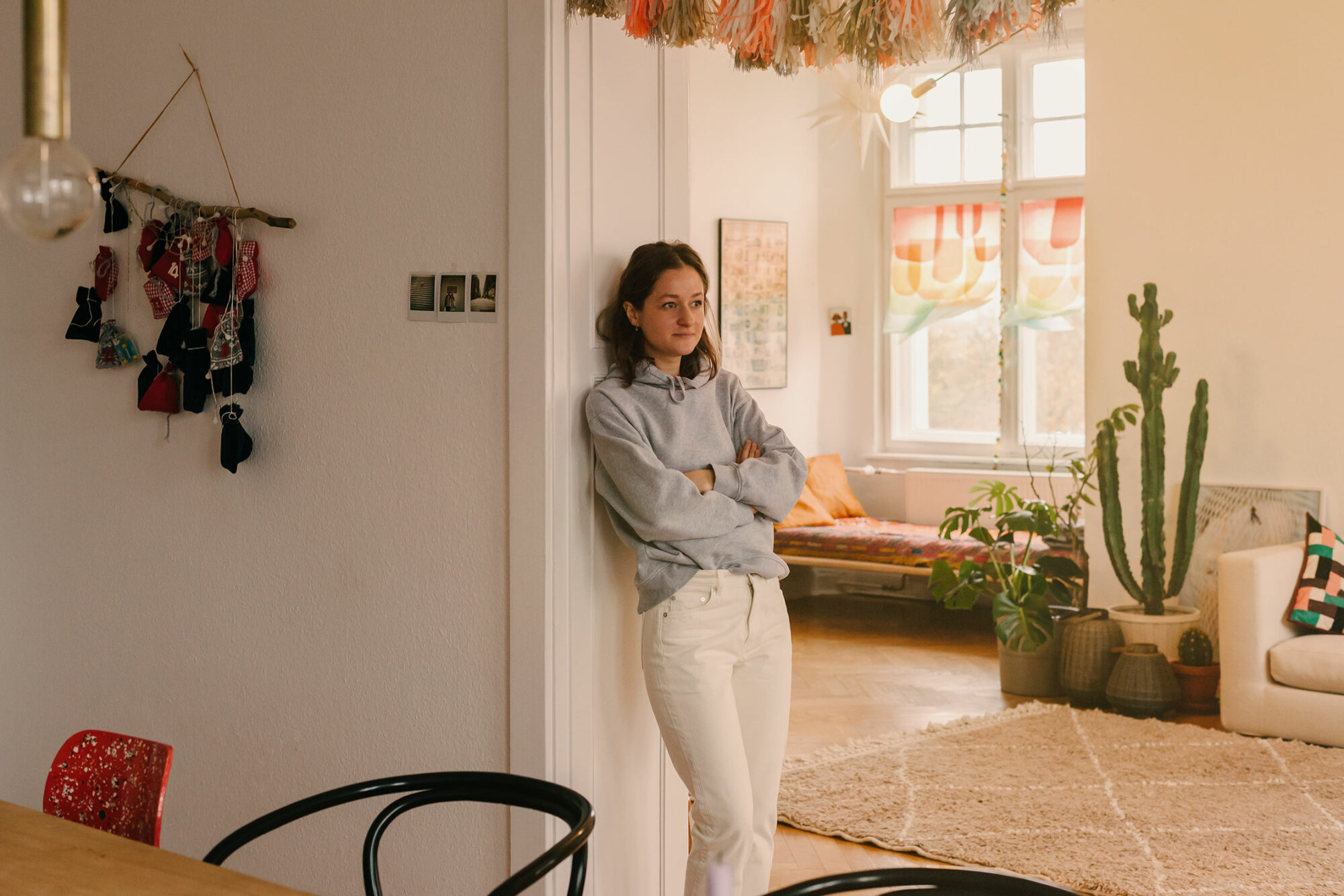
What happens when you strip away the frantic cycles of high fashion to focus entirely on the memory, weight, and quiet utility of what we wear? For Letizia Caramia and Morten Thuesen, the two creatives behind the design studio OLDER, the answer lies in the radical simplicity of the uniform. Bridging Milanese heritage with Danish functionalism, the duo has spent over a decade turning utilitarian garments into avant-garde statements of intent.
In our conversation, they open up about the garments they cherish forever, the intuitive boundaries that protect their professional and romantic partnership, and why their studio in Milan is their creative sanctuary.

-
FvF
Garments hold memory. If you had to pick one piece of clothing you’re fond of because it holds a specific memory of your journey together, what would it be?
MortenI have a 3XL flannel shirt that I bought in LA, where we were together with friends, and I always bring it with me wherever we go. I don’t use it often, as it’s very thick–workwear, high quality, very durable. I always sleep with a pillow between my legs, and when I travel, I use the shirt: It’s a token of safety. And a great memory, bringing me back to that trip. I’m not the biggest fan of nostalgia, actually even try to fight it. But the shirt is an exception.
LetiziaI have a lot of items like these that should go into the bin, but I can’t possibly get rid of them. Like this shirt, a piece from a friend’s graduate collection, from when we studied together, that’s completely worn out after 20 years. It’s so unique, since I cannot buy it again, made to measure for my body. I also use it as a reference for other pieces, finding some of its elements again in other items, like aprons. I also have a shirt from my grandmother, which I love, and also tried to copy in my atelier.
MortenYou keep a lot more things than I do–my willingness to throw things out is much bigger. I was really inspired by science fiction, particularly A book called ´Do Androids Dream Of Electric Sheepby´, the American writer Philip K. Dick. It has a term for things that should be discarded, ‘kipple’, and we’ve adopted that word in our family.


-
FvF
After a big project wraps, what’s the first simple thing you crave?
MortenWe have a very close relationship to the countryside where Letizia is from. So when a big project has landed, I very often find myself longing for a non-aesthetic place. It relaxes the brain. You can totally OD on design. Where Letizia is from, a beautiful part of Tuscany, there’s a kind of wonderful absence of design; everything is very simple. It takes me to a mindset that massively helps me wind down.
LetiziaWith two young kids and us working together, everything is a bit blurred. When you have small kids, life after work is high intensity. The oldest is four, the younger only 11 months. My real job really starts at 5:30pm when the ‘official’ job is over. So in a way, decompression isn’t what it used to be. Milan is a city built for people to work and then leave–it’s always been like that. So the decompression happens once we leave the city. Luckily, everything is close by.


-
FvF
Working together as partners in both life and work suggests your creative lives and daily realities seem quite intertwined. How do you protect your individual rhythms amidst this shared creative one?
LetiziaMorten and I started OLDER in 2013, and we’d been a couple for only about a year before that.
MortenWe started really early, we were 23 and 24. OLDER has been a slow burn, a step-by-step development. So when things grow organically, you learn to implement boundaries much more easily. Letizia, particularly at the beginning, was very specific about that–drawing lines. The pandemic taught us a lot too. There were concrete periods where these things came naturally. Today it’s very intuitive–we don’t have a specific set of rules.
LetiziaI’ve always been good at switching off. And Morten has really benefited from that influence. Not stepping on each other’s roles came intuitively. The best idea always wins. We try never to take it personally. We don’t usually interfere with each other during the very first part of the creative process; only once it’s about the details do we start working together. We’re good at different things, which makes it easier too. Morten is more of a generalist, but he’s the real artist–that’s his mindset. He has a lot of ideas, does a lot of research. He suffers more.
MortenThe artist is defined by suffering–so Italian. (laughing)
LetiziaI am more of a specialist, and follow the development and production much more closely. I know the limitations of materials and production, so I’m always the one bringing the restrictions to the table. The usual process is that Morten gets the inspiration and starts the development, then I come in later to make it work, to bring it to reality.
MortenWe almost conceive OLDER more like a piece of technology than a uniform label, in the way, that uniforms solve problems for it’s users and need the ability to upgrade, depending on the sector where it operates. This also regards the supply chain, production, and so on.

-
FvF
How do you capture fleeting ideas or sensory impressions that you know will later inform a collection or uniform concept?
LetiziaOn archiving: That often goes back to nostalgia. We have so many prototypes, we archive them in boxes, and of course a lot of displays in our showroom.
MortenThe beautiful thing about working with uniforms is that there’s no seasonal approach, no collections. So we have a lot of time to experiment with ideas. Recently we experimented a lot with high-visibility garments. Taking the time to fall in love with an idea is crucial for us. That’s also what led us to a solid design process. Often the job is to reduce more than to design. Reduction is a tool we use to strip things back. Working with what you have is a super huge part of how we work.
LetiziaMorten takes a lot of photos, and he sketches a lot. He zooms out with music, and a podcast, withdraws and draws.
MortenThe paradox is that Letizia is incredible at drawing–she has such incredible talent. I am rather limited. I draw in my notebook, but also digitally, whatever is in front of me, honestly.
LetiziaI love drawing, but these days I don’t have a lot of time. Whether it’s for work or with the kids, I just love it. When I do it for myself, I need time without interruptions. There’s not much time for it right now, which is absolutely fine, but I’m sure it will come back. Sometimes I can be almost robotic–I send myself emails. I am on my inbox homepage all the time. It’s the only place I let remind me of everything. Sometimes it’s just an email with keywords in the subject line, an idea. I have no problem with technology, keeping up with what’s new. But things like AI don’t interest me much. My Moleskine and my physical calendar are still essential to me.
MortenWith inspiration, you can just feel that this or that will matter. It can be so many different things, but it almost reveals itself as an idea, an emotion. Right now, we’re very into meta ideas, internet aesthetics. We’re drawn to people in uniforms performing, dancing. The idea of breaking out of your routine, which is what we’re aiming to build into our design. Architecture is a huge inspiration too.


-
FvF
Your work is deeply embedded in contemporary design culture, aesthetics, and functional object-making. What’s one object in your home that’s absolutely essential to your well-being but has nothing to do with your professional creative disciplines?
MortenBack to the nostalgia thing: I think everything in our home is dispensable, somehow. I don’t really feel like there’s something I’d miss that much. Of course, pieces hold emotions, hold stories.
LetiziaBesides the essential things like washing machines etc., this space was completely empty when we moved in. Even the kitchen is custom-made, we have an industrial sink, for example. And we used a lot of pieces from Morten’s dad’s office–industrial elements, not really ‘design’, and turned them into design ourselves–my dad works with wood and iron, and he helps us a lot with customization, that personal touch. So in a way, there’s nothing in our place that isn’t beautiful.


-
FvF
What’s the preferred soundscape of your daily life?
MortenI’m somebody who plays music pretty much all the time. It’s not a fear of silence, one of my favourite genres are ambient music. Music that almost emulates silence sonically, however my taste is eclectic. All genres. At work, we sit in different rooms, since Letizia needs more quiet for her work sometimes.
LetiziaMorten plays music very loudly in the studio, though.
MortenWe listen to a lot of radio channels, like NTS. We collect vinyl, too. Sound quality is not so essential–sometimes a great tune can come out of an iPhone.
LetiziaIn the waking hours of this family, there is always music. But when I’m alone, there is less music. I got so used to being fed music by Morten that I got a little lazy on my own. I really enjoy his selection. It’s only rare that music is on, like a radio channel, and then I start to think, hmm, something is bothering me.
MortenMy early inspiration was hip hop, and I got into sampling a lot. That’s where the eclectic selection came from. It’s very often about the rabbit hole, the curiosity. I can be completely blind to what era or language something’s from. And then sometimes Letizia comes in and has to stop me.


-
FvF
What about your favorite olfactory experience?
LetiziaOh, we’re incense people–not extreme, though. We have a few we really like, and we stick to them.
MortenWe’re not radical about it, though. It’s not a focus.
LetiziaYesterday we had a meeting, and my father was in the studio, making sweet-and-sour aubergine, so sometimes we have to burn some incense to set the tone for client meetings, cleanse the air.


-
FvF
What about lighting? You have so many extraordinary lamps in here.
MortenI am very radical on that point. Living in Italy, with so many beautiful lamps, companies making amazing lighting, I am often surprised by how bad lighting is in a lot of Italian places. The Scandinavian way is candlelight–always that orangey coloring, which is what I’ll always prefer.
LetiziaI don’t like ceiling lights that much, I prefer floor-level, indirect lighting.
MortenIn our entrance, we have a projector Afra and Tobia Scarpa created for Benetton stores in the 1980s. It’s almost cinematic projector lighting. However, almost every other light source in this space has a candle, warm-lit quality to them.


-
FvF
By redefining the concept of the ‘uniform’ for cultural institutions, high-end hospitality, and modern workplaces, your work directly interacts with corporate identity, hierarchy, and social structures. Does elevating a utilitarian garment into an avant-garde statement feel like an act of quiet resistance or societal affirmation? In a world saturated with fast fashion, how does the integrity of your clothing serve as a socio-political statement?
LetiziaThat’s the main reason we started OLDER as a uniform brand. When we were very young, we loved the idea of making clothes, but had no idea what it meant to run a brand, distribute, produce. We had to learn it all from scratch. And we quickly realized the world doesn’t need another luxury brand. So we felt rather shallow and empty, but still wanted to dress people. That’s where we started thinking about purpose, something that’s accessible to people like us, something you’d feel proud to wear, but not just an ego-driven product.
MortenIn many ways, we prefer to suggest ideas. We don’t like being preached to, or told what to do. Uniforms have that wonderful ambiguity.
LetiziaIt’s a statement when people choose us. There are so many aprons out there. A basic apron that costs 5 euros can look just as chic. But it’s about how things are made, the sustainability aspect, being true to our values, having an honest supply chain. That’s all quite political, in the end.
MortenThere are social layers in there. Uniforms can be quite loaded like that. If we’re doing our job well, the people who buy them know this is a conscious alternative where the process is interwoven into the piece. You shouldn’t feel that you’re wearing something intellectual; you should ultimately feel good wearing it.

-
FvF
Your work is about dressing the human form, creating uniforms that give identity and dignity to others. As the years pass, your own bodies are changing too, I guess. How has your relationship with your own physical self changed since starting OLDER?
MortenOur uniforms should be beautiful on all sizes. Uniforms are performative garments, almost like for athletes. Dressing diversity beautifully is something that matters, body inclusivity in our uniforms matter a lot us when we design them.
LetiziaOften, particularly, the chef shirt and the apron are more male garments. Our aim is for everyone to look stunning, independent of body shape.


-
FvF
Tailoring and high-end design require precision, control, and structural strength. Where do you allow for vulnerability within this process? Is it a private space shared only during the friction of the design, or something you weave into the conceptual narrative of the garments themselves?
LetitziaIt’s a good question. I think there should be vulnerability in every aspect of the process. When we’re more vulnerable, we’re more emotional.
MortenThe products are communicated and produced very sincerely. The vulnerability makes them authentic.


-
FvF
Your partnership bridges distinct European design perspectives—Milanese heritage and sensibilities with Danish functionalism and minimalist discipline. If you could host a dinner with any creative figure, living or dead, from a discipline outside of fashion and industrial design, who would you choose, and what would you talk about, assuming you could not mention their actual work?
MortenI would have loved a very Italian lunch with the Russian filmmaker Andrei Tarkovsky. His poetry in his films is so inspiring. Just being in his presence would be amazing. He had a period in Italy where he made a film called “Nostalgia”, and I’d love to talk about food with him.
LetiziaThere’s an Italian writer, from Sicily, called Andrea Camilleri–I’ve read almost all of his books, from my teenage years onward. It’s my summer reading. He created fictional books about a “commissario”–he writes a lot in dialect, about food and culture. I would love to have lunch with him, just to talk about everyday things. Once a journalist asked him about how hard the phase of creating must be. His answer was very poetic, it’s like a dancer on the stage, who doesn’t show to the public all the pain of training behind a beautiful show. So the artist shouldn’t show the suffering of the creative process either. If you share that with your audience, you’re taking away the lightness, the inspiration you can give them. You can bring someone joy without explaining the process, the struggles. Sometimes we need the illusion.


-
FvF
If the tools you work with—the wools, the fabrics, the pattern-cutting tables, the tailor’s shears—could reveal one truth about your creative partnership that the public never gets to see, what would it say about your moments of frustration, contemplation, or breakthrough?
LetiziaOur team could answer this so much better!
MortenThey’d say that our process is a lot calmer than people would expect. I hope our tools would say that we use them with respect, that they are used in a safe and sound environment. There can be complaints about the techno banging, but hopefully the clarity and calmness is what they’d talk about.
LetiziaIt’s been a very stable phase for a few years now–we have a great team of eight, and it’s all very harmonious. Usually Morten and I go out for lunch, and the team stays at the studio and cooks. It’s like a big family. There’s not much drama–not like the glamorous world of high fashion. Probably the objects would be bored, since they expected a lot more drama.